Cork model railway roadbed ballast (underlay strips and sheets)
Railway modelling can’t be left to chance – it’s hard to build a realistic track layout using foam, cardboard or plastic. Experienced modellers have relied on natural cork for years. It’s a material that perfectly recreates the character of a railway embankment while also dampening vibrations and being easy to work with. Because in railway modelling, the end result matters – the layout shouldn’t look like a toy, but like a real railway in miniature.


No products found.

Have questions? Check out our answers!

WHAT IS MODELING CORK?

It’s natural cork specially designed for building railway layouts. It’s most commonly used as an underlay beneath the tracks – helping the trackwork look realistic while keeping it stable and quiet.

WHY NATURAL CORK?

Quite simply, because it works exceptionally well. It has a natural structure made up of microscopic air-filled cells, which means it’s excellent at absorbing noise and vibrations – making trains running across the layout much quieter.

Cork is also flexible yet stable. It doesn’t crumble like polystyrene or crack like cardboard. It gently compresses under pressure but returns to its original shape, keeping the track bed even and durable.

Appearance matters too. The natural colour and texture of cork resemble real ground, so even the underlay itself helps create a realistic scene.

What’s more, cork is a natural, renewable and non-toxic material. If you’d rather not build your layout using plastic, it’s a very sensible alternative.

CORK FOR MODEL TRAINS – WHAT WILL I FIND IN THIS CATEGORY?

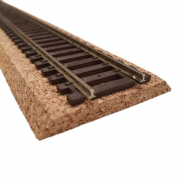
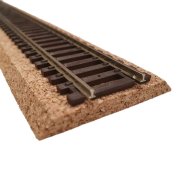
Cork track bed strips are ready-made cork profiles for laying beneath the tracks, shaped to resemble a real railway embankment. They feature bevelled edges and are designed specifically for the H0 scale.

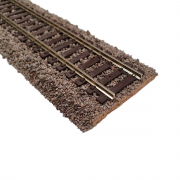
Cork ballast, meanwhile, is a fine cork aggregate designed to imitate real railway ballast and gravel. It’s used to finish the trackwork – between the sleepers, around the rails and along the embankments. It helps give the layout a natural and highly realistic appearance.


Modeling cork is one of those materials that genuinely makes a difference when building a layout. There’s no need to improvise with cardboard, foam or random underlays that end up warping over time or transferring every bit of noise onto the baseboard. Instead, you get a ready-made solution that provides a stable and realistic track bed from the very start. The biggest difference is noticeable when the trains are running. Cork effectively absorbs vibrations – and on larger layouts with longer train sets, the improvement in comfort is incomparable.


IAnother major advantage is how easy cork is to work with. You can cut it effortlessly with a standard modelling knife, shape it to fit curves or turnouts, and quickly create a realistic railway embankment beneath the tracks. No dust, no battling with hard materials, and no wasting time on endless adjustments.


Cork track bed strips help maintain the correct track geometry. That’s especially important when the layout is meant to last for years rather than just being a temporary project. Fewer adjustments over time mean more time spent actually enjoying the modelling itself. Cork ballast, meanwhile, makes it easy to achieve a realistic finish without weighing the layout down with heavy stone. It looks natural and spreads easily.


Cork has another advantage that many modellers appreciate – it’s a natural material. It doesn’t look plastic or create an artificial effect; even its texture resembles real railway ground. That makes it much easier to build a layout that still looks realistic up close. For many people, it’s simply a more enjoyable way to build a layout. Instead of working with more synthetic foams and plastic components, you’re using a natural material that’s safe and biodegradable. It means you’re not filling your layout with yet another artificial product.