
.png)

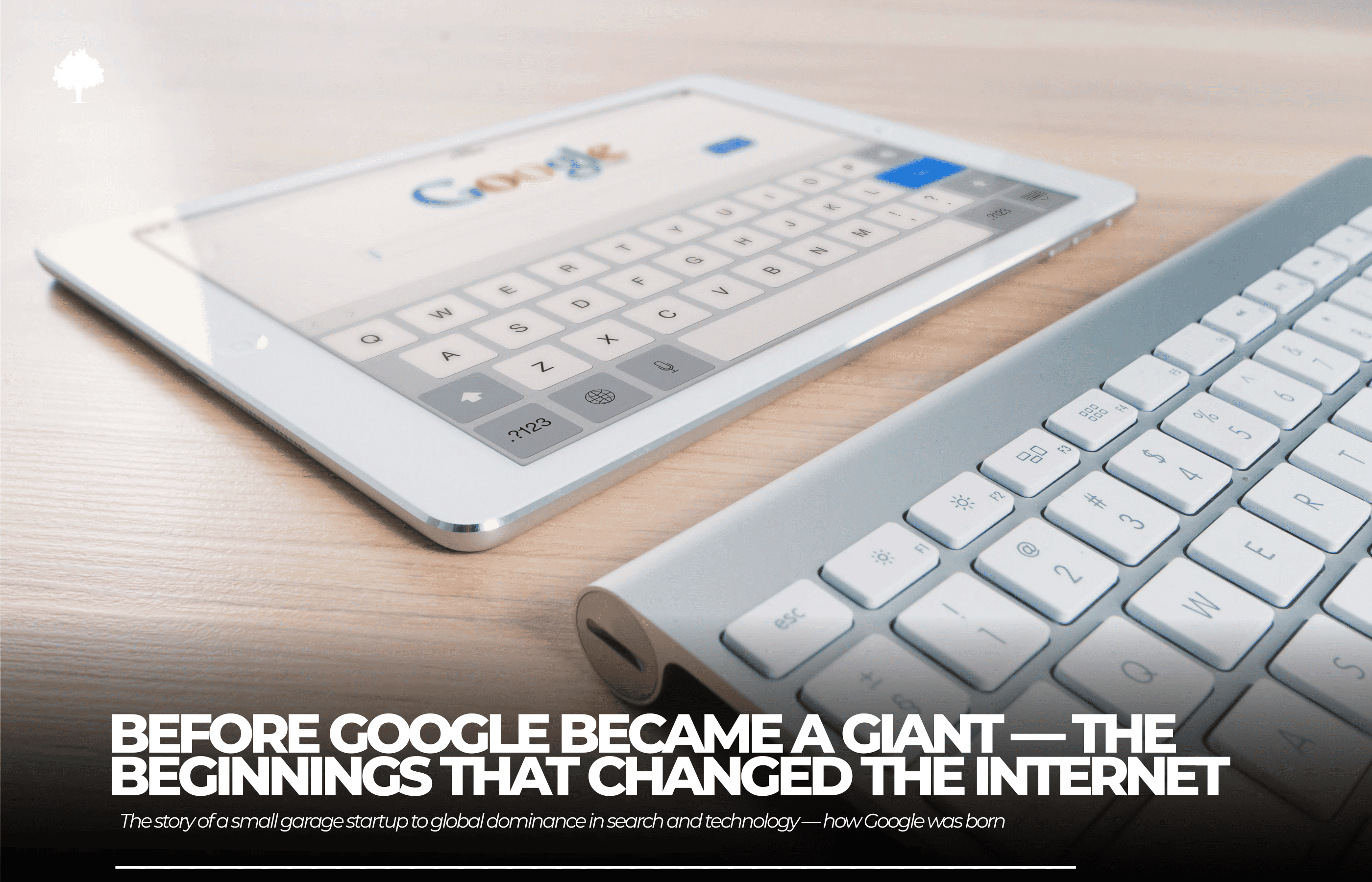
Today, it is hard to imagine the internet without Google. The search engine has become so deeply embedded in everyday life that it is almost “invisible” — it is simply there. Yet Google was not always a global technology powerhouse. The company was officially founded on 4 September 1998, and its early days were modest, worlds apart from today’s multi-billion-dollar data centres and worldwide infrastructure.
Those formative years of Google also come with an intriguing anecdote. Few people realise that in Google’s very first server racks, motherboards were placed on pads made from… corkboard.
Table of Contents
1. Introduction
2. Google before it became a giant
3. Servers on… a corkboard – a true story
4. Cork in a technology museum
5. Why did they choose cork?
6. Where is cork used today?
7. Summary
8. FAQ
Google before it became a giant
In 1999, Google was still a fledgling startup, only just beginning to move beyond the academic setting of Stanford and operate as an independent company. There was no strong brand recognition, no international offices, and no major capital backing. What did exist, however, was a concept — the PageRank algorithm — and the conviction that web search could be done better than anyone had achieved before.
Financial resources were scarce, while demands increased almost daily. As the search engine attracted more users, one challenge became unavoidable: processing ever larger volumes of data. Google could not afford costly, enterprise-grade technologies, so from the outset it relied on resourcefulness, creativity, and squeezing the most out of what was available.
Servers on… a corkboard – a true story
The phrase “corkboard server rack” may sound today like an inside joke or an online myth, yet it refers to a very real and well-documented phase in Google’s history. These were the company’s first operational server racks, used in its own data centre around 1999, once it had moved beyond purely academic experiments.
So what did such a rack actually look like? In simple terms: a home-built server structure that abandoned standard metal enclosures. Instead, motherboards, hard drives, power units, and fans were mounted on natural cork (or cork-like material), set on basic shelves within a metal frame. The system was open, tightly packed, and aggressively cooled by dozens of fans.
Natural cork played a highly practical role in this setup. It was inexpensive and easy to source, functioning as:
-
a spacer separating electronic components from the metal frame,
-
a basic form of electrical insulation.
Why was this approach so clever — at that time? Because it matched the real needs of a young startup perfectly. Google needed to build substantial computing capacity quickly and cheaply. Commercial server racks were expensive, rigid, and designed for large corporations rather than a rapidly scaling search engine. The “corkboard server rack” enabled Google to:
-
expand its infrastructure at remarkable speed,
-
use low-cost, widely available PC components,
-
quickly swap out and adapt hardware,
-
operate faster and more economically than competitors.
Cork in a technology museum
Today, one of Google’s original cork-based server racks is no longer hidden away in an old server room, but instead occupies a place of honour at the Computer History Museum in Mountain View — one of the world’s leading technology museums. This is where artefacts that genuinely shaped computing and the internet are preserved.
Why did such a rough, almost “garage-built” construction earn a permanent place in a museum collection? Because it represents a turning point. This unassuming rack illustrates how the infrastructure of a company now handling billions of daily searches first came into existence. It is admired not for its appearance, but for the principle behind it: maximum performance achieved with minimal means.
Google’s cork rack became a museum exhibit because it tells the behind-the-scenes story of the digital revolution. Instead of polished enterprise servers, we see improvisation, trial and error, and the courage to challenge conventions. It proves that breakthrough technologies are not always born in pristine laboratories — sometimes they emerge on a corkboard, assembled from inexpensive parts and powered by bold ambition.
Why did they choose cork?
The decision to use cork in Google’s first server racks was neither accidental nor “mystical”. It was not a materials experiment or an environmental statement — natural cork simply did the job. In the late 1990s, with tight budgets and enormous pressure to scale fast, tangible and practical characteristics mattered above all else.
First and foremost, natural cork is an effective electrical insulator. It separated motherboards and hard drives from metal structural parts, reducing the risk of short circuits in an open, enclosure-free system. In makeshift racks where electronics were fully exposed, this was critically important.
Secondly, cork was affordable, lightweight, and easy to work with. It could be cut, replaced, and adjusted quickly without specialist tools. For a startup assembling its own servers almost on a daily basis, this flexibility was invaluable.
Where is cork used today?
Google’s story places cork in an unexpected technological role, yet the material itself has long enjoyed an exceptionally broad and modern range of uses — particularly where performance, durability, and comfort are key considerations.
Construction and insulation
Cork is highly valued as an insulating material. It is commonly used in the form of:
-
insulation panels for walls, roofs, and façades,
-
cork underlays beneath floors, improving thermal and acoustic insulation while enhancing walking comfort.
Thanks to its structure, cork retains heat efficiently, resists moisture, and maintains its properties over time.
Interiors and design
In contemporary interiors, cork increasingly plays an aesthetic role as well. It appears as:
-
decorative wall panels,
-
upholstered features,
-
cork flooring that blends natural appearance with everyday comfort.
Cork’s natural texture adds warmth to interiors and complements both minimalist and organic design styles.
Acoustics
One of cork’s greatest strengths lies in its sound-absorbing qualities. It effectively reduces echo and noise, which is why it is used in:
-
conference rooms,
-
recording studios,
-
open-plan offices,
-
educational and cultural spaces.
Offices, homes, and public spaces
By combining insulation performance, durability, and visual appeal, cork is used in private homes, modern offices, and public buildings alike. It excels wherever user comfort, good acoustics, and resistance to heavy use are essential.
From Google’s improvised servers to contemporary architecture and design — natural cork remains a material that proves its value in practice, regardless of scale or application.
Summary
The story of Google’s cork-based servers is more than a technical footnote from the late 1990s. It illustrates how major ideas can emerge from humble beginnings, and how constraints can spark innovation. Before Google became one of the world’s most influential technology companies, it was a startup that improvised, experimented, and sought the simplest workable solutions.
Natural cork — now associated with construction and interior design — played an unexpected yet very tangible role in that journey. Not as a symbol of sustainability or futuristic technology, but as a practical solution that enabled a young company to build its first infrastructure quickly, affordably, and effectively.
FAQ – natural cork
1. What is natural cork?
Natural cork is a material harvested from the bark of the cork oak. It is lightweight, flexible, durable, and entirely natural, with a structure that provides excellent thermal and acoustic insulation.
2. Which properties make cork so versatile?
Cork is:
-
an effective thermal and acoustic insulator,
-
electrically non-conductive,
-
resistant to moisture and mould,
-
elastic and resistant to deformation,
-
pleasant to the touch and quiet in daily use.
These characteristics are exactly what make cork effective across such a wide range of applications.
3. Why did cork prove effective even in such an unusual application as Google’s servers?
Because it provides natural insulation, vibration damping, and electrical safety. Even when used in an improvised way, its core properties were genuinely beneficial.
4. Is natural cork a durable material?
Yes. When applied correctly, cork retains its properties for decades. It does not crumble, lose elasticity, or deteriorate under intensive use.
5. Is cork an eco-friendly material?
Yes. Cork is a renewable raw material — it is harvested without cutting down trees, and its production has a low carbon footprint. This is one reason it is increasingly returning to modern architecture and design.


