
.png)

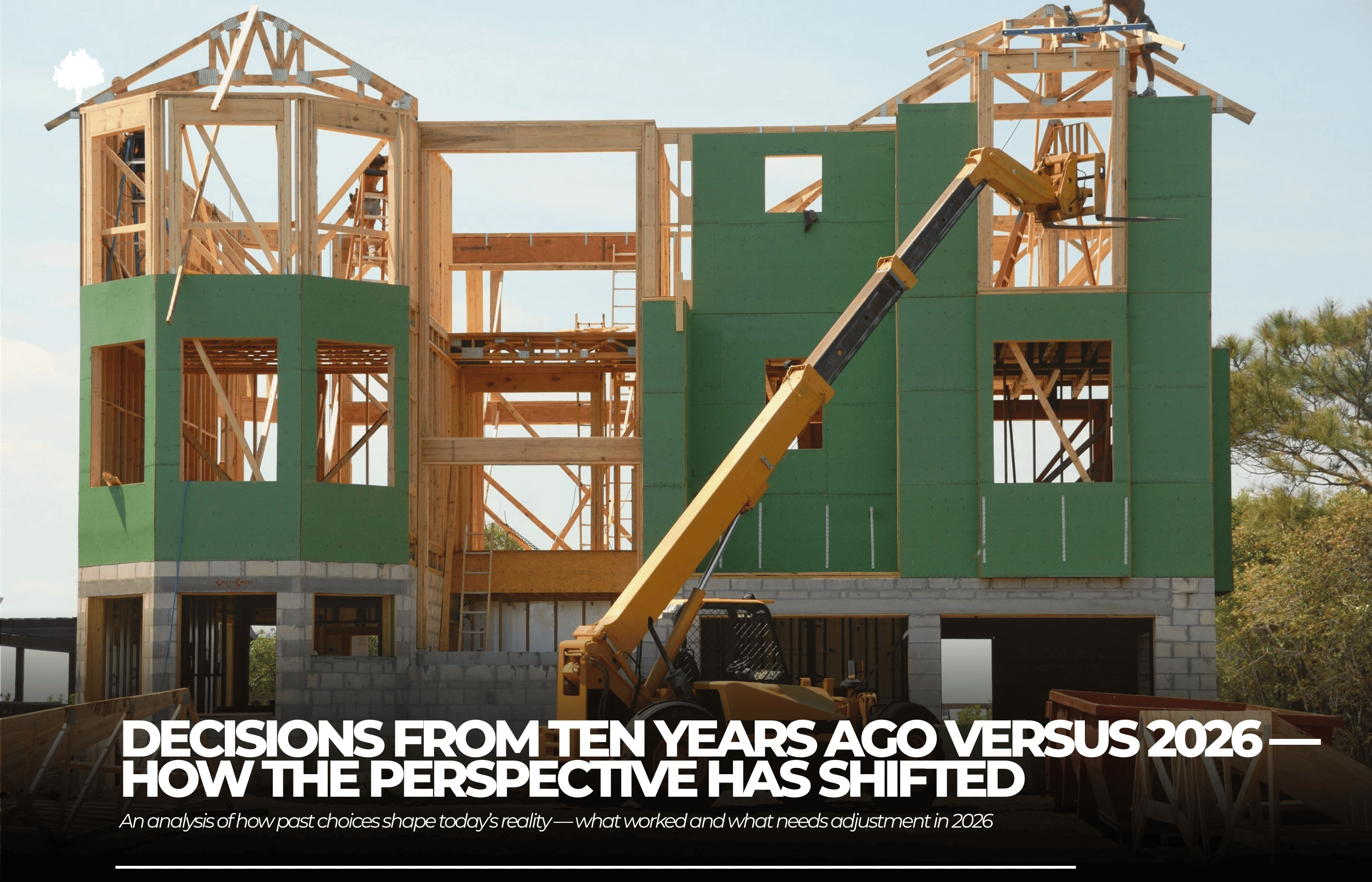
A decade in construction and interior design can feel like both an eternity and a brief moment. Back in 2015, countless decisions were taken with the best intentions — guided by current trends, manufacturers’ catalogues, advice from contractors, and real budget constraints. We are now in 2026. Many homes, apartments, and offices are reaching a point where the outcomes of those decisions are becoming noticeable — not just in terms of appearance, but in financial terms as well.
This article is not meant to judge the past or criticise choices made years ago. Instead, it offers a balanced look at why certain decisions felt self-evident in 2015 and why they are now leading to unexpected expenses in 2026. Above all, it explores what ten years of real-world experience can teach us moving forward.
Table of Contents
1. Introduction
2. Why did these decisions seem obvious in 2015?
3. Decorative wall panels: the “wow” effect that quickly faded
4. Floors from 2015 versus the reality of 2026
5. Floor underlays: an invisible decision with visible consequences
6. Home insulation: when “good enough” stops being enough
7. What do all the mistakes of 2015 have in common?
8. Summary
9. FAQ
Why did these decisions seem obvious in 2015?
To properly understand the decisions made around 2015, it helps to revisit the conditions of that period — calmly and without hindsight bias. The construction and interior design sectors were experiencing rapid expansion. Projects were completed quickly and at scale, often as “firsts”: a first flat, a first home, or a rental investment. It was only natural that most choices followed what was readily available, widely recommended, and labelled as modern.
Interior and construction trends around 2015 were clearly defined and widely shared. Smooth finishes, strong textures, glossy or perfectly even matte surfaces, geometric shapes, and consistent colour schemes prevailed. Interiors were expected to look “straight out of a catalogue” — flawless, orderly, and free from natural imperfections. In construction, priority was given to systems that were quick to install and offered predictable costs, helping projects stay on schedule.
At the same time, there was intense pressure around budget, timelines, and a contemporary look. Both private and commercial investors operated within strict financial limits. Materials that delivered instant visual impact at a relatively low price naturally came out on top. “Modern” became a goal in itself: the more precise, technical, and flawless something appeared, the better it matched expectations of the era.
Just as influential were materials that performed exceptionally well in catalogues, showrooms, and trade exhibitions. Decorative panels, laminated flooring, thin surface claddings, and synthetic finishes offered exactly what the market wanted: an eye-catching result immediately after installation. Under showroom conditions — ideal lighting, no moisture, and minimal wear — they seemed hard to beat.
Decorative wall panels: the “wow” effect that quickly faded
Around 2015, decorative wall panels were enjoying peak popularity. MDF, PVC, and laminated surfaces became common in homes, offices, hotels, and commercial interiors. They responded perfectly to the demand for a fast visual upgrade — a single statement wall that transformed a space without the cost and disruption of a full renovation.
What made them so appealing at the time was very clear. First and foremost, the price — decorative panels were considerably cheaper than natural cladding materials. Installation was quick and straightforward, often completed within one or two days and without major interference elsewhere in the interior. Appearance also mattered: uniform patterns, pronounced 3D textures, on-trend colours, and finishes inspired by concrete, wood, or stone. The “wow” factor was instant and reliable.
The issue was that these materials were developed mainly to impress at first glance, not to withstand long-term use. After several years — and even more so after a decade or longer — the limitations of this approach became increasingly apparent.
With time, distortions began to appear — panels responded to temperature and humidity changes, bending, separating at joints, or pulling away from the wall. Even occasional, barely visible moisture caused MDF to swell, discolour, and lose stiffness. Ageing of the surface was unavoidable: fading, microcracks, and loss of colour or sheen turned what was meant to be a decorative feature into something that simply looked worn.
Decorative panels made of natural cork
In contrast, natural cork offers a fundamentally different philosophy of wall design. It is far more resilient to the passage of time, moisture, and temperature variation. Thanks to its cellular structure, it moves with the building rather than resisting it. It does not swell, crack, or lose its structural stability under normal conditions.
Its aesthetic qualities are just as important — cork ages gracefully rather than deteriorating. It does not imitate other materials; it remains true to itself. Over the years, it develops depth, character, and a natural patina instead of looking dated or worn. As a result, cork walls do not need replacing simply because fashions change.
Floors from 2015 versus the reality of 2026
In the mid-2010s, the flooring market was largely dominated by laminated panels and budget engineered floors. These products were easy to source, offered countless design options, and promised impressive “technical specifications” on paper. For many investors, they seemed like an obvious solution — attractive, quick to install, and easy to budget for.
The laminated flooring boom played a major role. Surface designs increasingly mimicked wood, stone, or concrete, while abrasion ratings became key selling points. Engineered floors were marketed as combining the look of a natural material with “modern technology” at a lower cost than solid wood. In 2015, this felt like a reasonable balance between appearance and affordability.
Years later, issues that were rarely addressed in client discussions at the time became impossible to ignore. Noise was one of the first — panels laid over rigid substrates amplified footsteps, which proved especially problematic in apartments and multi-level homes. Another drawback was the sensation of a cold floor, affecting both comfort and actual energy use for heating. Local damage posed further challenges: a cracked board, water damage, or permanent deformation often meant removing large sections or even the entire floor.
Cork floors
Against this backdrop, cork floors present a very different approach to everyday use. Their elasticity allows them to absorb daily loads more effectively while remaining comfortable even after years of heavy use. Cork compresses slightly underfoot and then returns to its original form, helping to reduce both fatigue and noise.
One of their most appreciated qualities is natural warmth underfoot. Cork acts as an insulator, preventing heat loss through the floor. In real terms, this translates into better thermal comfort and tangible energy savings, particularly during colder months.
Floor underlays: an invisible decision with visible consequences
In 2015, floor underlays were often treated as little more than a technical formality. They were hidden from view, had no impact on interior aesthetics, and rarely featured prominently in investor conversations. The underlay was seen as “the cheapest component” — an area where savings seemed harmless.
The dominant assumption was that since the underlay would be covered by flooring, its quality mattered less. Priority was given to meeting manufacturer requirements and keeping costs as low as possible. As a result, underlay choices were often made automatically, without considering how they would perform over many years.
The most common options included PE foams, XPS boards, and thin synthetic mats. They were easy to install, lightweight, readily available, and inexpensive. Initially, they did what was expected — smoothing minor imperfections and reducing noise to an “acceptable” level. However, many of these materials were never designed for prolonged, dynamic loads. Over time, their limitations became clear. They compressed permanently, lost elasticity, and stopped performing their role. This led to worsening acoustics, louder and more hollow footsteps, and vibrations spreading through the building structure. Panel joints also suffered, as insufficient support caused micro-movements, joint failure, and accelerated wear of the entire floor.
Cork underlays for floors
Cork underlays follow a completely different principle. Their defining advantage is long-term performance stability — cork does not suffer permanent compression and maintains its elasticity and load-bearing properties even after many years. This ensures consistent and predictable floor behaviour.
Just as important is effective sound insulation. Unlike many synthetic alternatives, cork retains its acoustic qualities over time. As a result, acoustic comfort is not temporary but an enduring feature of the flooring system.
Home insulation: when “good enough” stops being enough
In 2015, insulation was primarily assessed through compliance with regulations and control of investment costs. The goal was to ensure that a house met the insulation standards of the time while staying within budget. “Good enough” summed up the prevailing attitude perfectly.
Materials such as expanded polystyrene, mineral wool, and various insulation foams dominated the market. They were widely used, well known to contractors, and easy to incorporate into building designs. Their technical properties were clearly specified, and their pricing allowed for precise cost planning. For most investors, they represented a safe and widely accepted choice.
From a 2015 standpoint, these solutions made perfect sense because they addressed the needs of that moment. By 2026, however, the long-term costs are becoming increasingly evident. Many property owners now face expensive upgrades and thermal retrofitting. Removing outdated insulation, correcting detailing, filling gaps, or replacing entire systems often results in costs far higher than the initial price difference between materials.
Expanded cork
Within this context, expanded cork stands out for its emphasis on durability and long-term reliability. It is a material designed to last for decades rather than a few seasonal cycles.
One of its major strengths is its natural resistance to moisture, mould, and pests. It requires no additional chemical protection, allowing it to maintain its properties even in demanding environments.
Another advantage is that it combines thermal and acoustic insulation in a single material. Expanded cork not only limits heat loss but also effectively reduces noise, enhancing comfort inside the building. Over the long term, these stable, all-in-one solutions often prove to be the most economical — despite higher upfront costs.
What do all the “mistakes” of 2015 have in common?
Viewed from 2026, decisions made ten years earlier reveal a clear common thread. The issue is not specific products or technologies, but the mindset that shaped those choices. That way of thinking explains why solutions that once seemed reasonable now generate additional costs.
The first factor was short-term thinking. Decisions were typically made with only a few years in mind, not decades. The priority was completion, sale, formal acceptance, or quick occupancy. The question “how will this perform in 10 years?” rarely entered the conversation — not because it lacked relevance, but because it was never standard practice.
Closely tied to this was a focus on initial price rather than overall cost. Materials were compared mainly based on purchase and installation expenses, while long-term costs related to maintenance, replacement, or disposal were largely ignored.
Finally, many projects were designed for handover rather than everyday use. What mattered most was that everything looked right on completion day — clean, precise, and aligned with the design. Daily comfort, acoustics, warmth, and ease of repair were secondary, as they were harder to quantify or present visually.
Summary
Decisions taken around 2015 were not mistakes in the traditional sense. They reflected the realities of that period — dominant trends, available technologies, budget constraints, and the pace of execution. The issue was not intent, but the limited time horizon that rarely extended beyond project completion.
By 2026, it has become clear that many materials and systems were never designed for long service lives. Wall panels, floors, underlays, and insulation once deemed “good enough” are now generating costs — financial, functional, and often environmental. Replacement instead of repair, renovation instead of renewal, noise instead of comfort — these are the tangible outcomes of short-term decision-making.
The conclusion drawn from these experiences is straightforward: the cheapest option at the start is rarely the most economical over time. Materials that age poorly and fail to work in harmony with both the building and its users inevitably return as problems requiring attention.
FAQ
1. Could these problems really have been predicted back in 2015?
Not entirely. At that time, long-term material ageing was rarely discussed openly, and many solutions were still relatively new. Investors relied on the knowledge, trends, and recommendations available then. The insights we have today are the result of ten years of experience, not easily predictable errors.
2. Does this mean all materials from 2015 are bad?
No. Many materials continue to perform adequately, particularly in less demanding conditions. The main issue lies with products designed for quick visual impact and low upfront cost, rather than long-term durability.
3. Why is cork discussed more today than it was 10 years ago?
Because priorities have shifted. Durability, everyday comfort, acoustics, energy efficiency, and long-term costs now matter more than ever. Natural cork meets these expectations while ageing well — which makes it far more relevant in 2026 than it was in 2015.
4. Is cork only suitable for “eco” interiors?
No. This is a widespread misconception. Cork is a high-performance technical material that works equally well in modern, minimalist interiors, commercial spaces, and buildings with demanding acoustic and thermal requirements.


