


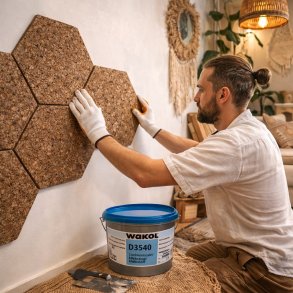
Cork contact adhesive Wakol D 3540 0,8kg
WakolD3540-0,8
- secure payment!
- cheap shipping!
- express delivery!
- cheap shipping!
- express delivery!
In stock
£ 74.72
Everyone knows polystyrene – it’s cheap, so it’s everywhere. If the only thing that matters is the lowest price, it does the job. But what if you’re looking for something more? We often hear from people who are fed up with cold walls, noise and materials that trap moisture inside. They say outright that they don’t want to insulate their home with polystyrene and are looking for something natural instead. That’s when we suggest Expanded Cork Insulation – a 100% natural material. It’s a solution for you if you have cold walls, want a quieter home and are looking for natural insulation instead of synthetic materials. If you’d like to find out whether expanded cork would be a good solution for your home, keep reading – we explain everything below.

Completely Natural Insulation

Comfort All Year Round

Noticeably Lower Bills

Chemical-Free

A Warm And Quiet Home

Durable For Years To Come
It is a completely natural insulation material in the form of boards. Expanded cork is often compared to popcorn because its production uses cork granules that are heated to a very high temperature (over 350°C). The material “pops” and expands in volume – just like popcorn. As a result, it increases in size and forms its characteristic structure made up of millions of microscopic air-filled cells. It is this porous structure that makes expanded cork such an effective insulator. It works like a natural thermos – slowing down heat loss while also dampening sound.
During heating, a natural resin present in cork – suberin – is released. It acts like a glue, binding the granules into one block. So there is no need to use any artificial adhesives or chemical additives. The cork granules bind together naturally, which means the material remains 100% natural.
The result is lightweight yet durable cork insulation boards with low thermal conductivity (λ approx. 0.036–0.040 W/mK). Expanded cork also absorbs sound waves, reducing noise by several dozen decibels (depending on the building system used in the project).
Expanded cork solves very specific problems you may deal with every day: a cold wall in your home, a room that heats up like an oven in summer, or echo and noise.
It works particularly well when:
However, this solution may not be the best choice if:
Not sure whether expanded cork will work for your project? Write to us. Describe the wall, the room or the problem you want to solve, and we’ll tell you exactly what you need.
Most cork products you’re familiar with – underlays for laminate flooring, cork boards, wall coverings – are made from so-called agglomerated cork, which is cork granules bonded together with a binder (adhesive). This is what we mean by “regular” cork. It has a lighter colour, a smoother surface and works very well as a finish for walls or floors, but its main purpose is not heavy-duty insulation.
Expanded cork has a dark, almost black colour, a porous structure and better insulating properties than standard cork. It is mainly used where stronger insulation is required.
If you’re looking for a decorative finish or a thin layer – choose classic agglomerated cork. If you want to properly insulate and soundproof your home while choosing a 100% natural material – we recommend expanded cork.
Yes. Expanded cork is a stable and long-lasting material. Its structure contains suberin – a substance that protects the material against moisture penetration and microorganisms. As a result, cork is resistant to moisture, mould, insects and rodents. When used in a properly designed building structure, it does not provide a food source for them.
Cork boards also maintain dimensional stability across a very wide temperature range – from around –180°C to +120°C. The material complies with EN 13170 and EN 13172 standards and carries the French A+ emissions rating, which means very low emissions of volatile substances indoors.
Polystyrene is cheaper and in that respect it has the advantage over cork. It’s a widely used insulation material, but compared with cork it has very little – in practice negligible – impact on room acoustics.
Expanded cork is more expensive, but it offers far more than just thermal insulation. It is a natural material that not only protects against heat loss but also significantly improves the acoustics of a room. Unlike polystyrene, it is a completely natural material.
Let’s compare the two materials:
In short: if price is your main concern – polystyrene may be the right choice. If insulation, comfort, durability and the natural origin of the material matter more – cork will definitely be the better option for you.
Yes. Before installing it, leave the cork in the room for around 72 hours, so the material can adjust to the temperature and humidity. This is important because cork is a natural material. If you install it immediately after delivery, it may later change slightly in size (shrink or expand). Allowing it to acclimatise helps prevent this issue.
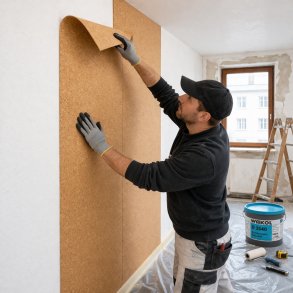
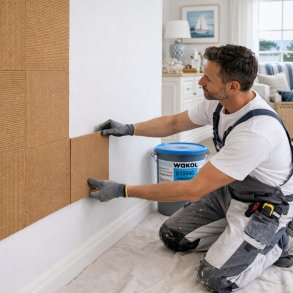
We recommend the Wakol D-3540 contact adhesive for cork. We use it ourselves when installing cork, and it works very well.
You’ll need about 100 g of adhesive per board. This means:
The adhesive provides a durable bond, provided the wall is clean, dry and level.
Standard expanded cork boards are mainly intended for indoor applications. If you’re considering using cork on a façade, this expanded cork would be the better option.
Yes. It is lightweight, easy to cut and works well in a terrarium designed to resemble a natural environment. However, if you are looking for materials specifically for a terrarium, we also have a separate category – branches, tubes and other decorative elements made from natural cork. These work even better because they are designed specifically for terrariums – providing hiding places and natural climbing structures.
Yes, paints for cork work best, but you can also use a good-quality wall paint.
Just keep in mind that expanded cork has a porous, irregular structure, so achieving a perfectly even, fully covering coat may be difficult.
Do you feel like the walls in your home are constantly cold? You keep the heating on, yet it still feels chilly? As a result, your bills keep rising, while true comfort at home remains out of reach. More and more people in this situation are choosing expanded cork, which solves all of these problems.

Thanks to its excellent thermal insulation properties, cork helps maintain a pleasant, stable temperature indoors. In winter, the heat stays inside, and in summer the interior heats up much more slowly. In practice, this means lower energy consumption for both heating and cooling. You stay comfortable regardless of the weather outside.
Expanded cork boards can retain their properties for several decades (often up to around 50 years). Just think about the savings – you install a solid insulation once and benefit from it for years, without replacements or repairs.
Expanded cork is one of the few insulation materials that is 100% natural. It is made exclusively from cork granules – without the addition of synthetic resins or adhesives. It does not emit harmful substances, does not produce dust, and works very well in homes where a healthy indoor climate is important (for example, households with children or people with allergies).
This matters because your home is where you spend a large part of your life. It’s worth looking not only at the appearance or performance of materials, but also at what they are made from. We’re surrounded by plastic in everyday life anyway – it’s good to have as little of it as possible in your home.
Cork is an environmentally friendly material. Although many products today claim to be “eco-friendly” (sometimes bordering on greenwashing), in the case of cork this is genuinely true. It is obtained from the bark of the cork oak, which is harvested without cutting down the tree. Interestingly, while the bark regenerates, the oak absorbs significantly more carbon dioxide, which is why cork production is considered to have a very low carbon footprint.
Compared with this, materials such as polystyrene or mineral wool come off rather poorly. They are produced through industrial processes that require large amounts of energy, and their production places a heavy burden on the environment. Cork is a natural and renewable material that doesn’t pretend to be ecological. It simply is nature.
| Format | Board |
| Colour | Dark brown |
| Length | 1000 mm |
| Width | 500 mm |
| Thickness | 25 mm |
| Material | Expanded cork |
| Installation | Glue |
D3540-0,8
In stock
£ 74.72
D3540-2,5
In stock
£ 99.72
D3540-5,0
- secure payment!
- cheap shipping!
- express delivery!
In stock
£ 130.09
041004005
- secure payment!
- cheap shipping!
- express delivery!
In stock
£ 99.72
3083
- secure payment!
- cheap shipping!
- express delivery!
In stock
£ 65.94

ZPM
Delivery time: 1 week
£ 92.84
ZPD
Delivery time: 1 week
£ 107.43
Customers who bought this product also bought
AK26-1
In stock
£ 55.57

EXP105001000
- secure payment!
- cheap shipping!
- express delivery!
In stock
£ 77.60

GK0510
- secure payment!
- cheap shipping!
- express delivery!
In stock
£ 57.36
RK-4U
In stock
£ 100.29
 Secure payments
 always free shipping
 Highest quality
 Satisfaction Guarantee