


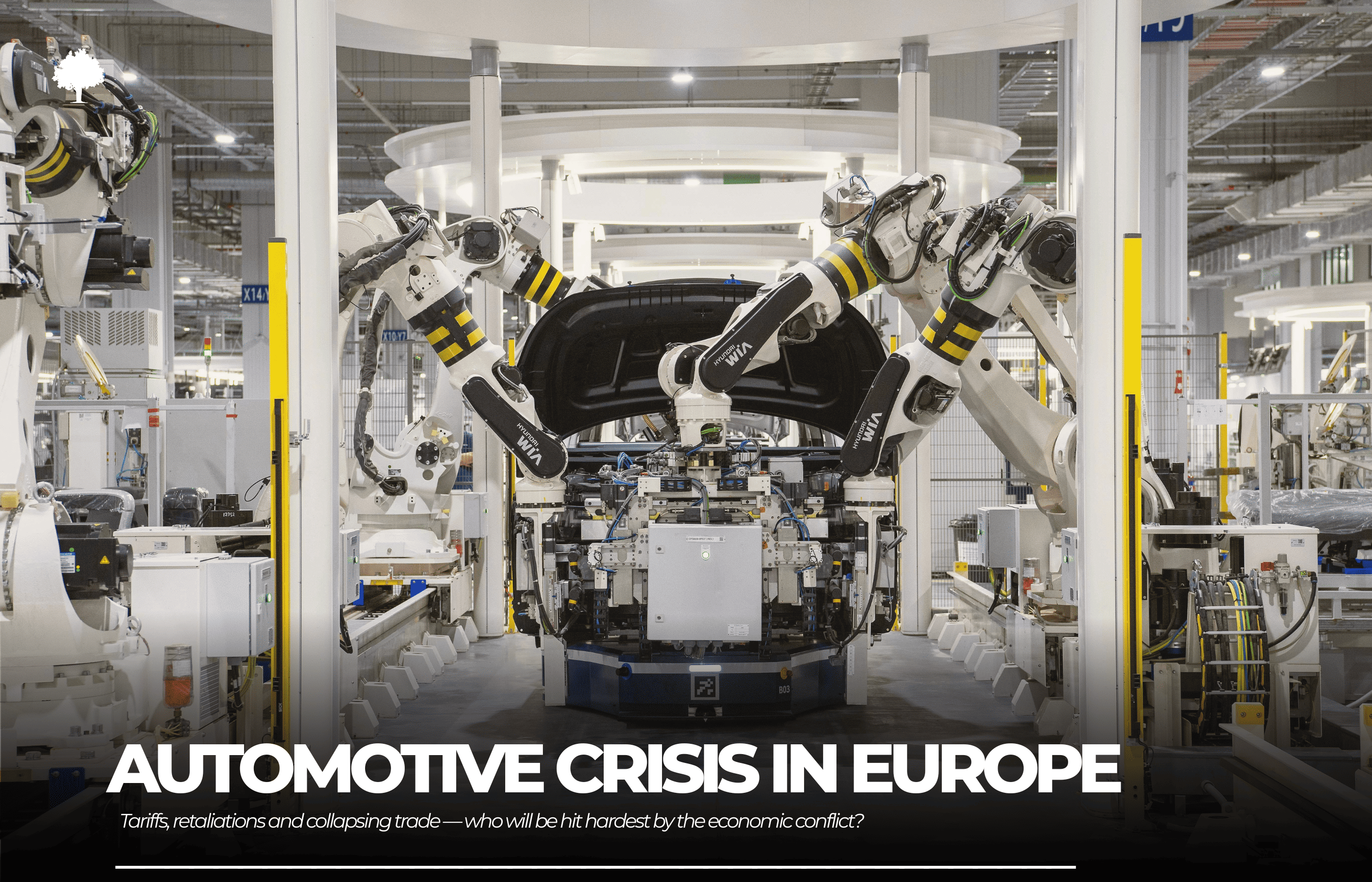
The European automotive industry is currently facing significant challenges. Mercedes-Benz and BMW, long associated with the premium segment and German engineering, are operating in an environment of growing competition and changing customer expectations.
In this article, we will look at the problems and changes taking place in the industry, including new market realities and manufacturers' strategies.
Table of Contents 1. Introduction 2. The European Automotive Industry Under Pressure to Change 3. Chinese Competition in the Electric Car Market 4. Eco-Luxury: A New Direction 5. Cork in the Automotive Industry – A Material with Potential 6. Summary 7. FAQ
The European Automotive Industry Under Pressure to Change
Changing Premium Car Sales Results in 2024 and 2025
European premium brands — such as Mercedes-Benz, BMW and Audi — have long been associated with modernity, quality and prestige. However, data from 2024 showed that manufacturers are now operating in a more demanding environment. Global deliveries by BMW, Mercedes and Audi were lower than a year earlier, although the scale of the changes varied between brands and markets.
In Germany and other major European markets, customers' decisions are influenced by factors including car prices, access to financing, the economic situation and the range of powertrains available. Asian manufacturers are also becoming increasingly strong competitors, particularly in the electric car segment.
Changing Preferences: Electric, Hybrid and Combustion-Engine Cars
The shift in powertrains is one of the most important processes in the industry, but it is progressing unevenly. Electric cars are becoming more popular, but they have not yet replaced combustion-engine cars on a mass scale. In 2025, they accounted for 17.4% of new registrations in the EU, while hybrids remained the largest segment.
For some drivers, an electric car means lower energy consumption while driving, quieter operation and modern technology. Others still choose petrol, diesel or hybrid vehicles, guided by price, range, access to charging and their own way of using the car.
Cost of Living and the Perception of Luxury
Rising living and financing costs may encourage customers to plan major expenses more cautiously. This also applies to premium cars, especially as their purchase price, insurance and servicing can place a significant burden on the budget.
For some buyers, luxury no longer means only a large engine or extensive equipment. Comfort, onboard technology, powertrain efficiency, material quality and the ability to tailor a car to individual needs may be becoming increasingly important.
Chinese Competition in the Electric Car Market
How Brands Such as BYD, Nio and MG Are Reaching European Customers
Just a decade ago, Chinese cars had limited recognition in Europe. Today, brands such as BYD, Nio, XPeng and MG are making their presence increasingly visible, offering electric cars with modern equipment, extensive digital features and competitive prices.
Chinese manufacturers invested early in the development of electric mobility, batteries and digital services. BYD is now one of the world's largest manufacturers of electric and plug-in hybrid vehicles, while models such as the Seal and Atto 3 are also available in selected European markets.
Nio is developing, among other things, a battery-swapping system as an alternative to conventional charging. MG, owned by the SAIC group, is building its position primarily through its range of electric and hybrid cars in more affordable price segments. However, sales volumes, model availability and service networks vary from country to country.
Why Chinese Cars Can Be More Affordable
The advantage of Chinese manufacturers stems from large-scale production, a well-developed supplier base and China's strong position in the battery supply chain. However, car prices depend not only on production costs, but also on exchange rates, taxes, equipment, logistics and trade policy.
The European Commission concluded that some electric car manufacturers from China had benefited from subsidies that distorted competition. Therefore, since 2024, the EU has applied additional countervailing duties on battery electric cars imported from China, including 17% for BYD and 35.3% for SAIC.
Chinese cars often stand out for their advanced infotainment systems, integration with mobile applications and extensive equipment packages. For some drivers, these are important advantages, but when making a purchase it is also worth considering servicing, the availability of spare parts, warranty terms and resale value.
The Response of European Manufacturers
Mercedes-Benz, BMW and Audi are developing their own electric models, software and digital services. Competition from Chinese brands is increasing pressure to introduce new technologies more quickly and offer more attractive pricing, but it does not automatically mean that European brands are losing their position.
Eco-Luxury as a New Direction
Consumer Trends: Luxury Is Increasingly Associated with Natural Materials and Sustainability
Today's consumers are increasingly viewing luxury more broadly than simply through the prism of precious metals, exotic leathers or chrome details. Quality of workmanship, durability, the origin of materials and a more responsible approach to production are becoming increasingly important.
For some younger customers, luxury is not about extravagance, but about combining functionality, refined design and a conscious choice of materials. In a world full of plastic and excess, natural textures, simpler forms and transparent brand communication can be perceived as elements of a premium product.
What matters is not only what can be seen, but also the information about the product: where the materials come from, what the production process looks like and what solutions have been used to reduce environmental impact. In Europe, requirements concerning transparency and product data are also becoming increasingly important, which is why automotive manufacturers are paying greater attention to the materials used in vehicle interiors.
Cork in the Automotive Industry – A Material with Potential
Properties of Cork
Cork is a lightweight natural material whose density — depending on the type and method of processing — usually falls within a range of approximately 120–240 kg/m³. Its cellular structure helps to dampen vibrations and provides resistance to compression, which means it can be considered for various technical applications, including in the automotive industry.
The natural structure of cork also provides insulating properties: thermal, acoustic and vibration insulation. The material can reduce the transmission of noise and contribute to interior comfort, although its effectiveness in a car depends on the form of the product, the thickness of the element, the installation location and the use of additional layers.
Cork has low permeability to liquids and is lightweight and flexible. However, to perform well in a car interior, it usually requires appropriate surface protection and testing for abrasion, UV radiation, temperature changes and contact with moisture.
Why Cork Is a Renewable Material
Cork is harvested from the bark of the cork oak (Quercus suber), which grows mainly in the Mediterranean region, particularly in Portugal and Spain. Harvesting the bark does not require the tree to be cut down, provided that it is carried out correctly: the first harvest usually takes place after around 25 years, with subsequent harvests taking place no more frequently than every 9 years.
Cork oaks can provide bark for many years, and the ecosystems in which they grow are important for the landscape, soil protection and biodiversity. Cork can be reused and recycled, although the actual environmental footprint of the finished component also depends on transport, adhesives, coatings and the entire production process.
Potential Applications in Premium Interiors
Cork can provide an interesting alternative or complement to leather, aluminium and plastics in car interiors. Its natural texture, warmth to the touch and ability to be coloured, embossed and perforated give designers considerable scope for creating individual finishes.
For brands such as Mercedes or BMW, the use of cork could be one element of a range of materials with a more natural character. However, cork alone does not determine the quality, luxury or environmental credentials of a car — these also depend on the design, durability, sourcing of the raw material and the entire production process.
Summary
The European premium automotive industry is currently under considerable pressure to change. Growing competition, the development of electric mobility, digitalisation and changing customer expectations are encouraging brands such as Mercedes and BMW to develop their technologies, material options and the way they communicate premium value. These are also key areas of the European plan for the automotive industry.
Traditional attributes of luxury — powerful engines, leather finishes or striking details — still have their audience, but they increasingly coexist with other selection criteria. For some customers, durability, material quality, the origin of raw materials, onboard technologies and the product's environmental impact are also important.
FAQ – Frequently Asked Questions
1. Is cork suitable for use in premium cars? It can be used as a finishing material or an insulating element if it is properly processed and protected. It is lightweight, flexible and has thermal and acoustic insulation properties, but its suitability for use in a car depends on the specific construction, coating and the results of durability tests.
2. Is cork a durable material? Cork withstands compression well and dampens vibrations, but its resistance to abrasion, moisture or UV radiation depends on the form of the material and the finish used. Cork-based composites are also used in specialised thermal insulation systems in the space industry.
3. Why are Chinese electric cars sometimes cheaper? Factors include the scale of production, a well-developed battery supply chain, component costs and industrial policy. The European Commission imposed additional countervailing duties on electric cars manufactured in China following an investigation into subsidies — demonstrating that prices also depend on trade and regulatory conditions.


