


Cork contact adhesive Wakol D 3540 0,8kg
WakolD3540-0,8
- secure payment!
- cheap shipping!
- express delivery!
- cheap shipping!
- express delivery!
In stock
£ 74.72
Polystyrene remains one of the most common insulation materials, largely because it keeps the initial cost low. It may be enough, but not everyone wants to base their choice on price alone. Some homeowners are looking for a material that can help with chilly walls and unwanted noise without relying on synthetic insulation. In these situations, Expanded Cork Insulation is an alternative worth considering. Made entirely from natural cork, it combines thermal and acoustic insulation in one material.

100% Natural Material

Year-Round Thermal Comfort

Helps Reduce Energy Costs

No Synthetic Additives

Better Warmth And Acoustics

Built For Long-Term Use
Expanded cork is a 100% natural insulation product supplied as boards. Its manufacturing process is quite unusual. Cork granules are heated to temperatures above 350°C, which causes them to expand considerably – a little like popcorn. This creates a highly porous internal structure containing millions of tiny air pockets. Those trapped pockets of air are responsible for much of cork’s insulating performance, helping to limit heat transfer while also reducing the transmission of sound.
The granules do not need to be joined with synthetic glue. High temperatures release suberin, a natural resin already present in cork. Suberin acts as the binder and holds the expanded granules together in a solid block. Because the material bonds using its own natural component, no artificial adhesives or chemical additives are required.
Expanded cork is useful when you want to deal with practical problems inside a building, such as cold surfaces, rooms that overheat during hot weather or excessive noise and echo.
It is particularly worth considering if:
Still unsure whether expanded cork is suitable for your application? Contact us and tell us what you are insulating, which room is involved and what problem you want to solve. We can then advise you on the most appropriate solution.
Many familiar cork products, including laminate underlays, wall finishes and standard cork boards, are produced from agglomerated cork. In this type of material, cork granules are joined using a binder or adhesive. This is what we refer to as standard or “regular” cork. It is usually lighter in appearance and smoother to the touch, making it a very good choice for decorative wall and floor applications, although it is not primarily designed for demanding thermal insulation.
Expanded cork looks quite different. It has a dark, almost black finish and a visibly porous structure. It also provides stronger insulation performance than conventional agglomerated cork, which is why it is commonly used when thermal or acoustic insulation is the main objective.
Expanded cork is highly durable and remains stable over long periods of use. One of the substances naturally present in its structure is suberin, which helps limit the penetration of moisture and protects the material against microorganisms.
Another advantage is the material’s dimensional stability. Expanded cork can retain its form over a broad range of temperatures, from approximately –180°C up to +120°C. It meets the requirements of EN 13170 and EN 13172 and has also received the French A+ classification for indoor emissions, indicating very low levels of volatile substances released into indoor air.
The main advantage of polystyrene is its lower price. This is one of the reasons it is so commonly used for insulation. However, its contribution to improving room acoustics may be minimal.
Expanded cork requires a larger initial investment, but its role is not limited to reducing heat transfer. Alongside thermal insulation, its structure can also provide a noticeable improvement in acoustic comfort. It also differs fundamentally in origin, as cork is an entirely natural material rather than a synthetic product.
The choice therefore depends on your priorities. If the lowest purchase price is the deciding factor, polystyrene may suit your needs. If you are more concerned with thermal and acoustic comfort, long-term durability and using insulation made from a natural raw material, expanded cork is likely to be the better fit.
Yes. It is best to place the cork in the room where it will be installed for approximately 72 hours before fitting. This allows the material to adapt gradually to the local temperature and humidity conditions. As cork is a natural material, installing it straight after delivery can lead to minor dimensional changes later, such as slight expansion or contraction. Giving it time to acclimatise helps reduce this risk.
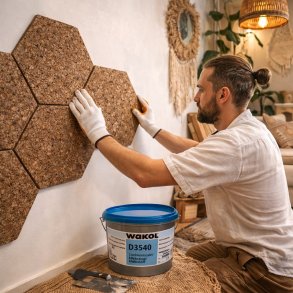
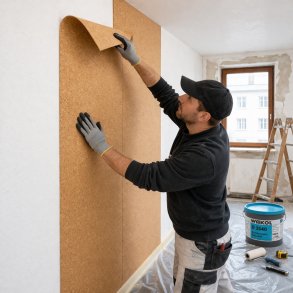
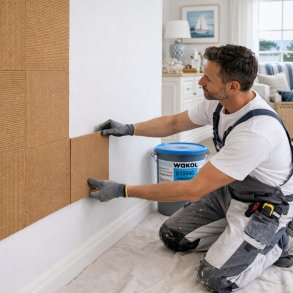
For bonding the boards, we recommend Wakol D-3540, a contact adhesive intended for cork. It is also the adhesive we use in our own cork installations, where it gives reliable results.
Allow for roughly 100 g of adhesive for each board. As a guide:
For the bond to remain strong over time, the wall should be properly prepared and must be clean, dry and even before installation.
Yes. Dedicated cork paints are usually the most suitable option, although a good-quality wall paint can also be applied.
Remember that the surface of expanded cork is naturally rough and porous. For that reason, the paint may not form a completely smooth or perfectly uniform covering, even when applied carefully.
Does your home still feel cold even when the heating is running? Perhaps the walls stay chilly, and you end up using more energy without getting the comfort you expect. In situations like this, expanded cork can help by improving thermal performance and making the interior feel more comfortable throughout the year.

Cork provides effective thermal insulation, helping to keep indoor temperatures more comfortable and consistent. During colder months, it slows down heat loss, while in summer it helps reduce how quickly rooms warm up. This means less energy may be needed for heating and cooling, making it easier to maintain a pleasant indoor climate in different seasons.
Another advantage is its longevity. Expanded cork boards can continue performing for many decades, often for around 50 years. Once the insulation is fitted correctly, it can remain effective for years without frequent replacement, helping you avoid repeated costs later on.
Expanded cork stands out because it is made entirely from natural material. The boards are produced from cork granules without synthetic resins or added adhesives. They do not release harmful substances or create dust, which makes them a suitable choice for interiors where indoor air quality matters, including homes with children or allergy sufferers.
The composition of building materials is worth considering, especially when they are used in spaces where you spend hours every day. Performance and appearance are important, but so is what the material actually contains. Since synthetic materials are already present in so many everyday products, choosing natural insulation is one way to reduce their presence inside the home.
Cork has strong environmental credentials that come directly from the way it is sourced. The bark is removed from cork oak trees without felling them, and it naturally grows back over time. During this regeneration period, the trees absorb increased amounts of carbon dioxide, which contributes to the relatively low carbon footprint associated with cork production.
This sets cork apart from materials such as polystyrene and mineral wool, which rely on industrial manufacturing processes that consume substantial amounts of energy. Cork is renewable and comes directly from a natural source, so its environmental benefits are not simply the result of an “eco” label – they are built into the material itself.
| Format | Board |
| Colour | Dark brown |
| Length | 1000 mm |
| Width | 500 mm |
| Thickness | 60 mm |
| Material | Expanded cork |
| Installation | Glue |
D3540-0,8
In stock
£ 74.72
D3540-2,5
In stock
£ 99.72
D3540-5,0
- secure payment!
- cheap shipping!
- express delivery!
In stock
£ 130.09
041004005
- secure payment!
- cheap shipping!
- express delivery!
In stock
£ 99.72
3083
- secure payment!
- cheap shipping!
- express delivery!
In stock
£ 65.94

ZPM
Delivery time: 1 week
£ 92.84
ZPD
Delivery time: 1 week
£ 107.43
Customers who bought this product also bought
MVCB1
In stock
£ 65.12
XLVCB3
In stock
£ 79.96
GK12
- secure payment!
- cheap shipping!
- express delivery!
In stock
£ 218.83
EGC310
In stock
£ 105.13
 Secure payments
 always free shipping
 Highest quality
 Satisfaction Guarantee