


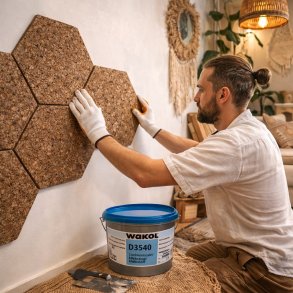
Cork contact adhesive Wakol D 3540 0,8kg
WakolD3540-0,8
- secure payment!
- cheap shipping!
- express delivery!
- cheap shipping!
- express delivery!
In stock
£ 74.72
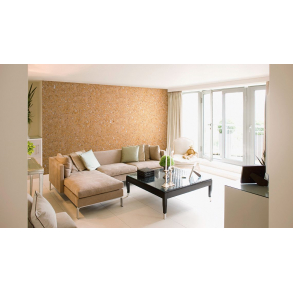
Some wall finishes make a great first impression, but their appeal quickly fades. What looks modern just after a renovation can start to feel dated after only a season or two. Natural cork takes a different approach. Bali Cork Wall Covering is made from natural cork, so it does not try to follow short-lived trends. It has its own texture and irregular pattern, which means the wall does not look like a “one-season” decoration, but rather a lasting part of the interior that can stay with you for much longer.
Organic Look

Safe For Interiors

Made To Last

Natural Cork

Creates A Cosy Interior

Easy To Match
Before fitting the decorative cork, give the panels 72 hours to acclimatise in the room. This allows the material to adjust to the humidity and temperature, helping to prevent issues such as the panels coming unstuck.
Bali panels are primarily a decorative wall covering, not an insulation material. Natural cork feels warm to the touch, so a wall finished with these panels does not feel as cold as, for example, tiles, concrete or stone.
If, however, your main priority is thermal and acoustic insulation, it is better to choose thicker cork boards or expanded cork.
No, it is best to install the cork wall covering on a surface that is smooth, clean, even and free from dust. Fixing cork to a rough or uneven surface may cause the panels to start coming unstuck.
The joints are usually slightly visible. If you allow the decorative cork to acclimatise for 72 hours in the room where it will be installed, the risk of gaps forming will be significantly lower. However, it is worth remembering that visible joints are a natural characteristic of the material.
First, clean the wall and remove any dust, grease and dirt so that the adhesive can bond properly. If there are any uneven areas, smooth them out using filler. For highly absorbent surfaces, such as concrete, prime the wall to ensure the adhesive bonds properly.
Use a slightly damp cloth or a soft brush for cleaning – this is enough for most everyday dirt. For more stubborn stains, use a mild cleaning product. Avoid strong chemicals such as acetone or bleach, as they can damage the appearance and structure of the cork.
Whether you are renovating your living room, designing a creative office or creating a cosy café, Bali cork wall covering is both stylish and incredibly practical.

Bali does not create the effect of a smooth, uniform wall. Its pronounced texture gives the surface greater depth and makes it look different depending on the angle of the light.
Natural cork has an irregular pattern, so individual sections may vary slightly from one another. These subtle differences are exactly what prevent the finished wall from looking like a printed pattern repeated every few centimetres, allowing it to retain the natural character of the material.
Smooth, light-coloured walls can look perfectly fine, but they often lack character. Bali brings a natural texture into the interior, instantly breaking up that effect and making the space feel more welcoming and less stark.
Cork works well with simple furniture, glass, metal and plain surfaces because it gives them a more natural backdrop. You do not need to cover the entire room either – often, one wall or a selected section is enough to give the interior a completely different feel. It is a particularly good solution when a room feels too cold visually, empty or “lifeless”, but you do not want to take on another major renovation.
Wallpaper can completely transform a wall, but the effect still relies mainly on a printed design. Even if the pattern imitates wood, stone or another natural material, the surface remains flat and repetitive.
Cork is different. Bali has a genuine texture and the natural pattern of the material, so the wall looks different depending on the light and the angle from which you view it.
Cork is used not because it is a “trendy eco-material”, but because it offers a combination of properties that is difficult to find in many other materials. It is lightweight, flexible, pleasant to the touch and has a natural texture that does not need to be artificially recreated through printing or embossing.
It is harvested from the bark of the cork oak without the need to cut down the tree. After harvesting, the bark gradually grows back and can be collected again. This is why cork has long been used not only in interior decoration, but also in construction, industry, gasket production and the protection of various surfaces.
| Model | Bali |
| Format | Tile |
| Length | 600 mm |
| Width | 300 mm |
| Thickness | 3 mm |
| Package | 1.98 m² (11 tiles) |
| Coverage | 0.18 m² (one piece) |
| Installation | Glue |
| Consumption of Wakol D-3540 Adhesive | 0.8 kg - an average of 4m² (about 22 panels), 2.5 kg - an average of 12.5 m² (about 68 panels) |
| Adhesive layer | No |
D3540-0,8
In stock
£ 74.72
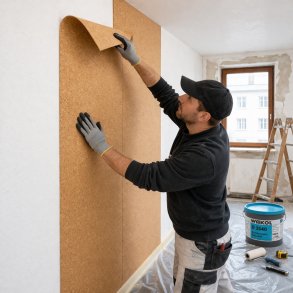
D3540-2,5
In stock
£ 99.72
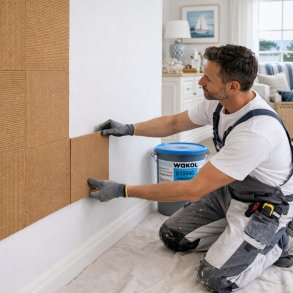
D3540-5,0
- secure payment!
- cheap shipping!
- express delivery!
In stock
£ 130.09
3083
- secure payment!
- cheap shipping!
- express delivery!
In stock
£ 65.94

ZPM
Delivery time: 1 week
£ 92.84
ZPD
Delivery time: 1 week
£ 107.43
Customers who bought this product also bought
AJ2Z001
In stock
£ 129.94
PK-4MM
In stock
£ 134.28
RY77002
In stock
£ 113.33
RK-10U
In stock
£ 191.68
 Secure payments
 always free shipping
 Highest quality
 Satisfaction Guarantee