


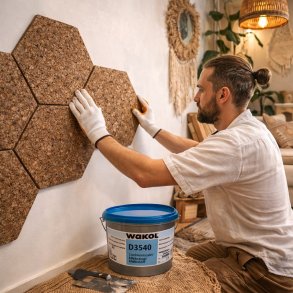
Cork contact adhesive Wakol D 3540 0,8kg
WakolD3540-0,8
- secure payment!
- cheap shipping!
- express delivery!
In stock
£ 78.33

Three-in-one protection: thermal, acoustic and vibration insulation

Made from 100% natural cork

Long-lasting performance you can rely on

Cost-effective insulation for the long term

Versatile insulation for a wide range of applications

Safe and dependable
Expanded cork is a natural cork material transformed through a specialist heat-expansion process. When exposed to high temperatures, the cork granules expand in a way similar to popcorn, while their naturally occurring suberin acts as a binding agent, holding the particles together without the need for synthetic adhesives. This treatment gives the finished material its distinctive deep brown appearance and enhances its thermal and acoustic insulation properties. The result is a durable, environmentally conscious insulation solution with low thermal conductivity, suitable for a wide variety of building applications.
High-density (HD) expanded cork boards offer a distinctive combination of natural composition, durability and insulating performance. Compared with commonly used alternatives such as mineral wool, polystyrene and polyurethane foam, cork provides several practical benefits, particularly for projects where sustainability, sound reduction and long-term reliability are important.
Mineral wool: Handling mineral wool can sometimes irritate the skin, eyes and respiratory system. Certain products may also experience reduced insulating efficiency if exposed to persistent moisture. Expanded cork, by comparison, is a naturally derived material that is generally comfortable to handle and does not require synthetic binders during manufacture. Its moisture-resistant characteristics can also help limit the conditions that encourage mould growth, making it an attractive option for healthier indoor environments.
Polystyrene insulation: Although widely used in construction, polystyrene can be vulnerable to physical damage and has limitations when exposed to elevated temperatures. Its disposal and recycling may also present environmental challenges. High-density expanded cork offers excellent dimensional stability, mechanical resilience and resistance to changing environmental conditions. As a renewable, recyclable material, it provides a more environmentally responsible alternative for projects prioritising durability and reduced environmental impact.
Polyurethane foam: Some polyurethane insulation systems require specialist application equipment and professional installation, potentially increasing overall project costs. Like many synthetic insulation products, polyurethane can also release hazardous fumes when burning. Expanded cork boards, on the other hand, can be cut and fitted using straightforward tools, making installation more accessible. Their natural composition, reliable insulating properties and long service life make them a practical choice for both domestic and commercial projects. Appropriate fire-safety requirements should always be followed, regardless of the insulation material selected.
The main distinction lies in the material's density. HD expanded cork insulation has a density of approximately 170–190 kg/m³, whereas standard expanded cork boards typically range from 110 to 120 kg/m³. This greater density makes the HD version particularly suitable for applications requiring increased mechanical strength and effective sound insulation, thermal protection and vibration damping. While both types offer valuable insulating properties, high-density cork is often preferred for more demanding acoustic and industrial applications.
Thanks to its combination of acoustic performance, thermal resistance and vibration-damping properties, HD expanded cork is suitable for an extensive range of applications. It can be used to insulate industrial machinery, mechanical equipment, residential interiors, refrigeration units and ventilation ductwork. High-density cork panels are also a practical solution for recording studios, music venues, schools, offices, commercial premises, factories, workshops, yoga studios, fitness centres, hotels and holiday accommodation where controlling unwanted noise is particularly important.
Within the building sector, expanded cork insulation boards can be incorporated into wall soundproofing systems, floor insulation and ceiling insulation for homes, commercial properties and energy-efficient buildings, including passive house projects. They may also be used in suitable flat roof, pitched roof and green roof constructions, providing long-lasting thermal protection while supporting more sustainable building practices.
Yes. For the best installation results, expanded cork panels should be left in the room where they will be fitted for approximately 72 hours before installation. This allows the material to adjust gradually to the surrounding temperature and humidity levels. Skipping this important preparation stage may increase the risk of dimensional changes, cracking or adhesion problems after fitting. Allowing sufficient acclimatisation helps ensure a more stable finish and supports the long-term performance of your cork insulation.
Proper surface preparation is essential for a successful installation. Before attaching expanded cork boards, make sure the substrate is clean, completely dry and free from dust, grease or loose material. An inadequately prepared surface can weaken the adhesive bond, potentially causing panels to lift, become uneven or develop visible gaps. Such problems may affect the finished appearance and lead to unnecessary repair work. Taking time to prepare the installation area correctly helps achieve secure adhesion, a neat finish and dependable insulation performance.
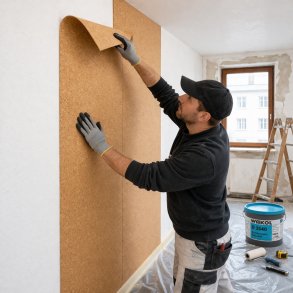
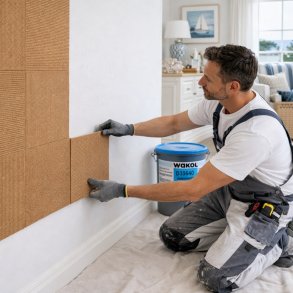
Fitting expanded cork insulation is relatively straightforward and does not normally require specialist machinery. You will need a measuring tape or straightedge, a suitable cutting knife, a spatula or application roller, and a reliable adhesive designed for cork products, such as Wakol D-3540 contact adhesive. When installing cork insulation panels on ceilings, additional mechanical fixings, such as suitable insulation dowels, are recommended alongside adhesive bonding to provide extra support and a secure, long-lasting installation.
As a general guide, allow approximately 100 g of adhesive per expanded cork insulation panel, depending on its dimensions and the application method. On this basis, a 0.8 kg container should be sufficient for around eight boards, while the larger 2.5 kg tub can cover approximately 25 boards.
The typical application rate for Wakol D-3540 contact adhesive is around 150–250 g/m². Based on an estimated consumption of 200 g/m², a 0.8 kg pack will cover approximately 4 m², while a 2.5 kg container provides coverage of roughly 12.5 m². Actual usage may vary according to the surface condition, porosity and application technique.
HD expanded cork is designed to perform across an exceptionally broad temperature range, from -180°C to +120°C. Its natural structure provides excellent thermal resistance and helps the material retain its mechanical properties under demanding conditions. This makes high-density cork insulation a versatile option for applications involving significant temperature variations, provided the selected product and installation system are suitable for the intended operating environment.
Choosing the right insulation for your project? With so many materials available, you might be wondering what makes expanded cork worth considering. The answer lies in its unique combination of benefits: it's naturally sourced, exceptionally durable and provides comprehensive insulation performance.
By choosing expanded cork, you're investing in more than just effective thermal insulation. You also benefit from excellent sound reduction, vibration damping and dependable protection, helping to create a more comfortable environment for many years to come.

Looking for an insulation solution that will stand the test of time, without the worry of frequently replacing conventional materials such as polystyrene or mineral wool? Expanded cork could be exactly what you need. Its naturally resilient structure and impressive durability make it a reliable alternative to many traditional insulation products, delivering consistent performance over an extended service life.
Expanded cork insulation helps maintain comfortable indoor conditions by reducing unwanted heat transfer and limiting noise transmission. It provides effective protection against heat loss during colder months and excessive heat gain in warmer weather. Thanks to their increased density, HD expanded cork anti-vibration panels are particularly useful for absorbing mechanical vibrations and reducing noise generated by heavy machinery and industrial equipment. This combination of thermal, acoustic and vibration control makes expanded cork a versatile choice for residential, commercial and industrial applications.
The environmental story of expanded cork begins long before the insulation boards are manufactured. Much of the world's cork comes from Portugal, where harvesting cork oak bark is a centuries-old tradition. Skilled workers carefully remove the outer bark using specialist hand tools, following techniques passed down through generations. The process allows the tree to remain standing and continue growing, making cork a remarkable renewable resource. Cork oak bark naturally regenerates approximately every 9–12 years, allowing repeated harvesting throughout the tree's lifetime. During bark regeneration, harvested cork oaks can absorb considerably more CO₂ than unharvested trees, with some estimates suggesting up to five times as much. This renewable cycle makes cork an appealing raw material for environmentally conscious construction projects.
Another significant advantage is what happens at the end of the product's useful life. Expanded cork is a natural, biodegradable and recyclable material. Where suitable collection and processing facilities are available, used cork can be repurposed into new cork-based products, helping reduce waste and conserve valuable resources. By supporting material reuse and more circular production methods, expanded cork insulation offers a responsible alternative for projects seeking to minimise their environmental footprint.
Installing expanded cork insulation boards can help industrial premises, manufacturing facilities and commercial buildings maintain a more consistent indoor temperature throughout the year. By limiting unwanted heat transfer through the building structure, cork insulation can reduce the demand placed on heating and cooling systems, potentially resulting in lower energy bills and improved operational efficiency.
During winter, expanded cork helps retain warmth inside the building, while in summer it can reduce the amount of external heat entering the property. This year-round insulating performance supports a more comfortable indoor climate and may help decrease energy consumption for heating and air conditioning. Combined with its durability and minimal maintenance requirements, expanded cork represents a worthwhile long-term investment for property owners looking to improve energy efficiency and manage running costs.
One of the most compelling advantages of high-density expanded cork is its ability to withstand years of use while retaining its essential characteristics. The material offers natural resistance to ageing, insects and rodents, alongside good dimensional stability under suitable installation conditions. With an expected service life that can extend to 50 years in appropriate applications, expanded cork insulation is designed for long-term performance. Even after decades of use, the material may continue to provide valuable thermal and acoustic insulation properties.
Although inspection, refurbishment or eventual replacement may be necessary depending on environmental exposure and installation conditions, expanded cork is valued for its extended service life and structural stability. Its robust composition makes it an attractive alternative to certain synthetic insulation materials, particularly where lasting performance and reduced maintenance are priorities.
High-density cork insulation also provides good compressive strength and natural resistance to moisture, making it suitable for a variety of demanding insulation applications. Its high suberin content contributes to its water-repellent characteristics and helps discourage conditions favourable to microbial growth. These inherent properties support the material's resistance to mould and fungal development, provided the surrounding building structure is properly designed and maintained. The result is a dependable, naturally derived insulation material that combines durability with effective thermal protection.
| Format | Board |
| Colour | Dark brown |
| Length | 1000 mm |
| Width | 500 mm |
| Thickness | 50 mm |
| Material | Expanded cork (HD) |
| Installation | Glue |
D3540-0,8
In stock
£ 78.33
D3540-2,5
In stock
£ 104.54
D3540-5,0
- secure payment!
- cheap shipping!
- express delivery!
In stock
£ 136.38
041004005
- secure payment!
- cheap shipping!
- express delivery!
In stock
£ 104.55
3083
- secure payment!
- cheap shipping!
- express delivery!
In stock
£ 69.13

ZPM
Delivery time: 1 week
£ 97.33
ZPD
Delivery time: 1 week
£ 112.63
Customers who bought this product also bought
XLVCT3
In stock
£ 83.83
SVCFP05
In stock
£ 64.37
XLVCFP3
In stock
£ 83.83
XLVCB3
In stock
£ 83.83
 Secure payments
 always free shipping
 Highest quality
 Satisfaction Guarantee