


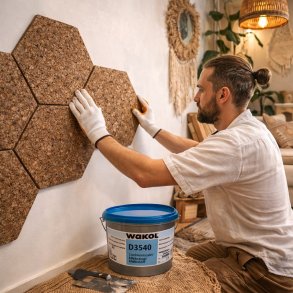
Cork contact adhesive Wakol D 3540 0,8kg
WakolD3540-0,8
- secure payment!
- cheap shipping!
- express delivery!
- cheap shipping!
- express delivery!
In stock
£ 78.33
A facade doesn't have to be smooth to look good. In fact, sometimes it's the uneven surface that makes it interesting. Take Wave L2 Expanded Cork Facade Panels, for example. Their deep, vertical waves create a distinctive three-dimensional pattern. And the design isn't their only advantage.

Wave Design

Natural Insulation

100% Natural Cork

Year-Round Comfort

Long-Lasting Material

For Facades and Interiors
Wave L2 could be right for you if:
The material itself has plenty of practical advantages.
Wave L2 panels are installed using adhesive on a properly prepared surface. However, you'll need to choose the adhesive according to where the panels are being fitted:
Whatever the location, the surface must be clean, dry, even and stable before you begin. Leave the panels to acclimatise for at least 72 hours, and plan their positioning carefully, so the deep waves meet neatly. If you're uncertain which adhesive is suitable for your project, get in touch – we'll help you choose.
For clean, accurate cuts, we recommend using a precision wood saw or another suitable tool with a toothed blade for wood.
Ever wondered how ordinary cork becomes expanded cork? The process is surprisingly similar to popping popcorn. Small cork granules are heated with high-temperature steam, causing them to swell and gradually turn darker. As they expand, the particles also bond together, forming solid blocks of material.
And here's what makes the process particularly interesting: no synthetic adhesives are required. The heat releases naturally occurring binding substances within the cork itself, allowing the granules to stick together.
Wave L2 panels have a density of approximately 140 kg/m³, with a tolerance of ±10 kg/m³.
Yes. Wave L2 Expanded Cork Facade Panels have a thermal conductivity value of λ = 0.043 W/(m·K). In simple terms, cork slows down heat passing through the wall. This helps keep more warmth indoors during winter and reduces the amount of heat entering the building in summer.
Of course, the final insulation performance depends on the entire wall structure, including its other layers and how everything is installed.
Each Wave L2 panel measures 1000 × 500mm, covering an area of 0.5 m². That means you'll need 4 panels to cover 2m². When calculating the quantity for your project, it's worth allowing a little extra for trimming, especially if you're working around windows, doors or corners.
The panels are 70 mm thick, allowing the deep waves and recessed sections to create their distinctive three-dimensional appearance.
Wave L2 panels have a Euroclass E reaction to fire classification. This means expanded cork is combustible and shouldn't be considered fireproof. However, it behaves differently from some synthetic materials when exposed to high temperatures. Rather than melting and dripping, cork tends to develop a charred surface layer. This can slow heat penetration into the material, although it doesn't stop combustion. Remember that the fire safety of the complete facade depends on the entire installation system, not just the cork panels.
Some joints may still be noticeable, even with careful fitting. Cork is a natural material that responds to changes in temperature and humidity, so slight dimensional movement is possible. Proper acclimatisation and accurate positioning of the panels can help keep the joints neat and the pattern consistent.
Yes, it's an essential part of preparing the panels. Before fitting them, allow at least 72 hours for the cork to adjust to the temperature and humidity of its installation environment.
Why wait three days? Because cork can undergo small changes in size as it adapts to different conditions. Installing the panels straight after delivery increases the risk of gaps or uneven joints developing later. Giving the material time to acclimatise helps prevent these problems and makes it easier to achieve a tidy, consistent finish across the Wave L2 pattern.
There's no shortage of materials for finishing a facade. Some are designed to resemble timber, others imitate stone, and many simply create a smooth, uniform surface. But what if you'd rather choose something with a completely different character? Wave L2 Expanded Cork Facade Panels combine natural cork with a striking pattern of deep, flowing waves. It's a finish that makes the most of the material's natural appearance rather than trying to look like something else.
That's one of the most interesting things about Wave L2. Its tall, flowing waves create a pronounced three-dimensional pattern, with raised sections that gradually widen and narrow. Rather than looking like a collection of separate panels, the surface develops a distinctive vertical rhythm.
It's a way to give your facade a completely different look without relying on bright colours, artificial finishes or additional decorations.
A facade should do more than make your home look interesting. It also needs to contribute to everyday comfort. Expanded cork helps slow down heat transfer through the walls, which means less warmth escaping during winter and less unwanted heat entering the building in summer. And if you live near a busy street, its sound-insulating properties can help reduce noise travelling indoors.
There's also the changing weather to consider. Rain, frost, strong sunshine and temperature fluctuations are all part of life for an exterior wall. Expanded cork is lightweight, dimensionally stable and vapour-permeable, making it a useful material for facade applications. Naturally, choosing the right adhesive and installing the panels correctly is essential. But when everything is properly fitted, Wave L2 offers practical benefits alongside its unusual three-dimensional finish.
There's a reason natural cork looks different from manufactured imitation finishes. Its texture and colour come from the material itself, not from a printed pattern designed to resemble wood or stone. And there's an interesting story behind it. In Portugal, cork harvesting is a traditional craft that requires considerable skill. Workers carefully remove the outer bark of cork oak trees by hand, without cutting them down or damaging the living parts of the tree.
What makes cork particularly remarkable is that the bark grows back naturally. After around nine years, the same tree can be harvested again, and this process can continue for generations. It's a renewable resource with a long history, and one that has found its way into modern building materials.
| Model | Wave L2 |
| Format | Board |
| Colour | Dark brown |
| Length | 1000 mm |
| Width | 500 mm |
| Thickness | 70 mm |
| Material | Expanded cork |
| Installation | Glue |
| Possibility of return | no return possible (custom made product) |
| Title | Type | Size | Download |
|---|---|---|---|
| Decorative-expanded-3D-facade-wall-natural-cork-insulation-panels-2.pdf | 4.69MB | Download |
D3540-0,8
In stock
£ 78.33
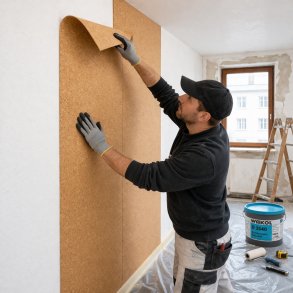
D3540-2,5
In stock
£ 104.54
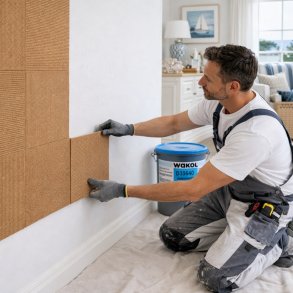
D3540-5,0
- secure payment!
- cheap shipping!
- express delivery!
In stock
£ 136.38
041004005
- secure payment!
- cheap shipping!
- express delivery!
In stock
£ 104.55
3083
- secure payment!
- cheap shipping!
- express delivery!
In stock
£ 69.13

ZPM
Delivery time: 1 week
£ 97.33
ZPD
Delivery time: 1 week
£ 112.63
Customers who bought this product also bought
D3540-2,5
In stock
£ 104.54
D3540-5,0
- secure payment!
- cheap shipping!
- express delivery!
In stock
£ 136.38
PD-V2
In stock
£ 121.14

KE-DEKOR
- secure payment!
- cheap shipping!
- express delivery!
Not in stock
£ 66.91
 Secure payments
 always free shipping
 Highest quality
 Satisfaction Guarantee