


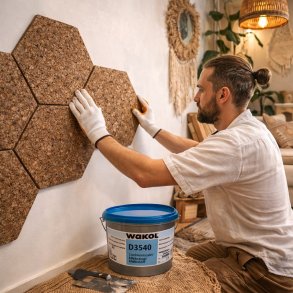
Cork contact adhesive Wakol D 3540 0,8kg
WakolD3540-0,8
- secure payment!
- cheap shipping!
- express delivery!
- cheap shipping!
- express delivery!
In stock
£ 78.33
Who says a facade has to be flat and smooth? Sometimes, it's the texture that makes all the difference. That's exactly what you'll notice with PointCloud Expanded Cork Decorative Facade. Their surface is covered in rounded recesses, creating a distinctive three-dimensional effect. But there's more to this material than an interesting pattern. Read on to learn more!

Distinctive Pattern

Natural Insulation

Cork 100%

Year-Round Comfort

Long-Lasting Material

For Facades and Interiors
PointCloud could be just what you need if:
The pattern might catch your attention first, but expanded cork has plenty more to offer when it comes to everyday performance.
PointCloud panels are attached directly to the prepared surface using adhesive. However, you'll need to choose the right adhesive for the location:
Whichever option you choose, the wall should be clean, dry, level and stable before installation. It's also important to let the cork acclimatise for at least 72 hours beforehand.
Not sure which adhesive is suitable for your surface? Just get in touch – we'll be happy to help.
There are two ways to arrange PointCloud panels, and both work well with their repeating circular texture:
You can see how the installation is done in both cases in the attachment (PDF file).
For neat, accurate cuts, use a toothed wood saw, or another suitable tool fitted with a toothed blade.
The production process is surprisingly straightforward. Cork granules are exposed to high-temperature steam, which causes them to swell and turn a darker colour. Think of popcorn expanding when heated – something similar happens to the cork. As the granules expand, they also bind together, eventually forming solid blocks.
The clever part? There's no need for synthetic glues or additional binders. Heating activates substances naturally present in the cork, allowing the granules to stick together without artificial adhesives.
PointCloud panels have a density of around 140 kg/m³, with a variation of ±10 kg/m³.
PointCloud panels have a thermal conductivity value of λ = 0.043 W/(m·K). This means expanded cork helps slow heat transfer through the walls. In colder weather, it reduces heat escaping from the building, while in summer, it helps limit the amount of heat passing indoors.
It's worth keeping in mind that the insulation performance of a finished wall also depends on its other layers and overall construction.
Each PointCloud panel is 1000 × 500mm, giving you 0.5m² of coverage. That makes calculating the quantity fairly simple – for a 3m² wall, you'll need 6 panels. If you're working around windows, doorways or corners, remember to allow some extra material for cutting and fitting.
The panels are 50 mm thick.
Expanded cork panels have a Euroclass E reaction to fire classification. Cork is combustible, so it shouldn't be confused with a fire-resistant or non-combustible material. However, its behaviour under high temperatures is worth understanding. Instead of melting and dripping, cork tends to form a charred layer on its surface. This layer can slow the movement of heat into the material, although it doesn't prevent combustion. The fire safety requirements of the complete facade system must still be taken into account.
They might be visible, and that's something to consider when planning your wall. PointCloud has a repeating pattern of circular recesses, so it's important to position the panels carefully where their edges meet. Cork also reacts naturally to fluctuations in temperature and humidity, which can cause slight dimensional changes. This doesn't necessarily mean you'll end up with very noticeable gaps. Giving the panels enough time to acclimatise and fitting them accurately will help achieve a more consistent finish.
Yes, and it's worth taking the time to do it properly. Leave the panels in the installation environment for at least 72 hours before fitting them. During this period, the cork can adjust to the surrounding temperature and humidity.
A facade doesn't have to be completely smooth to look good. Sometimes, a little texture is all it takes to change how a building feels. PointCloud Expanded Cork Decorative Facade takes this idea further with their rounded indentations and natural cork surface.

Even a simple texture can make a surface look completely different. And with PointCloud, that effect is particularly noticeable. Its rounded recesses create small areas of light and shadow, giving the facade a sense of depth that you simply don't get with a smooth finish.
The pattern has something of a golf ball texture, with circular indentations repeated across the surface. From a distance, they form an interesting, consistent design. Move closer, and you can appreciate the individual details. It's a good choice if you want your walls to have a bit more personality without introducing bold colours or elaborate decorations.
There's a practical side to PointCloud that you might not notice at first glance. Expanded cork acts as a natural insulating material, slowing heat transfer through the walls. That means less warmth escaping during winter and less heat making its way inside during summer. It also helps reduce noise coming from outside, which can make a real difference if your home is near a busy street.
Expanded cork is lightweight, dimensionally stable and vapour-permeable. It can cope with a wide range of temperatures, making it suitable for use on facades throughout the year. Of course, proper installation is just as important as the material itself, especially if you want the finish to last.
What makes cork particularly interesting is where it comes from. It isn't manufactured to resemble a natural material – it actually is one. Its journey starts with cork oak trees, mainly found in countries such as Portugal. There, harvesting the bark is a skilled trade that has been passed down through generations. Workers carefully remove the outer bark by hand, leaving the tree alive and able to continue growing.
And that's not the end of the story. The cork oak gradually grows a new layer of bark, which can usually be harvested again after 9–12 years. The same tree can provide cork repeatedly throughout its life. It's quite remarkable when you think about it – something that begins as tree bark can eventually become a textured facade panel, giving a building both a natural finish and useful insulating properties.
| Model | Golf (Point Cloud) |
| Format | Board |
| Colour | Dark brown |
| Length | 1000 mm |
| Width | 500 mm |
| Thickness | 50 mm |
| Material | Expanded cork |
| Installation | Glue |
| Possibility of return | no return possible (custom made product) |
| Title | Type | Size | Download |
|---|---|---|---|
| Decorative-expanded-3D-facade-wall-natural-cork-insulation-panels-3.pdf | 4.69MB | Download |
D3540-0,8
In stock
£ 78.33
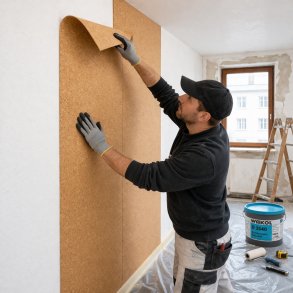
D3540-2,5
In stock
£ 104.54
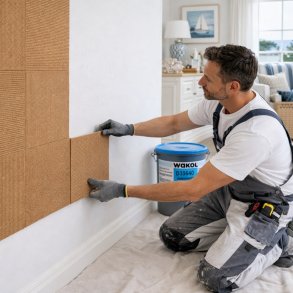
D3540-5,0
- secure payment!
- cheap shipping!
- express delivery!
In stock
£ 136.38
041004005
- secure payment!
- cheap shipping!
- express delivery!
In stock
£ 104.55
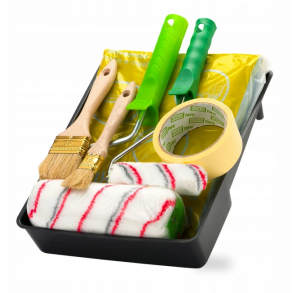
3083
- secure payment!
- cheap shipping!
- express delivery!
In stock
£ 69.13

ZPM
Delivery time: 1 week
£ 97.33
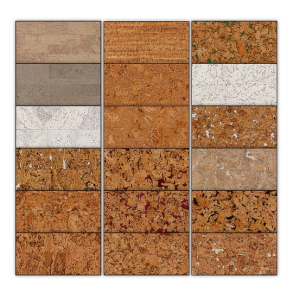
ZPD
Delivery time: 1 week
£ 112.63
Customers who bought this product also bought
D3540-2,5
In stock
£ 104.54

KE-40CM1
- secure payment!
- cheap shipping!
- express delivery!
In stock
£ 115.97

KE-20/50
- secure payment!
- cheap shipping!
- express delivery!
In stock
£ 33.97 for 4 pcs.

KE-DEKOR
- secure payment!
- cheap shipping!
- express delivery!
Not in stock
£ 66.91
 Secure payments
 always free shipping
 Highest quality
 Satisfaction Guarantee