


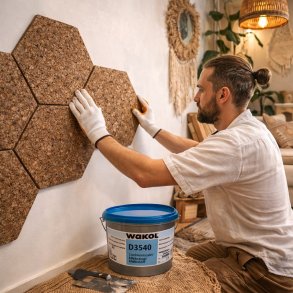
Cork contact adhesive Wakol D 3540 0,8kg
WakolD3540-0,8
- secure payment!
- cheap shipping!
- express delivery!
- cheap shipping!
- express delivery!
In stock
£ 78.33
A smooth, plain facade can look neat, but it doesn't always have much character. If you're after something a little different, the Circles Expanded Cork Facade Panels offer another option. Their circular shapes create an interesting pattern, bringing depth and casting subtle shadows as the light changes throughout the day. And there's more to these panels than their appearance. Made from natural expanded cork, they also provide thermal insulation and are designed to last for years.
Distinctive Pattern

Natural Insulation

100% Natural Cork

Year-Round Solution

Made to Last

For Exterior and Interior Walls
Circles panels could be right for you if:
There's more to expanded cork than its natural appearance. It offers several useful properties that make it worth considering for walls and facades.
Circles panels are installed using adhesive, but the right product depends on whether you're working indoors or outdoors:
Before you start, make sure the surface is even, dry, clean and stable. The panels should also be left in the installation environment for 72 hours to acclimatise. Not sure which adhesive will work best for your project? Get in touch and we'll help you choose.
For accurate cuts, we recommend using a precision wood saw or another suitable cutting tool with a toothed blade.
Think of what happens when you heat popcorn. The kernels puff up and change their structure. Expanded cork is produced in a surprisingly similar way. Cork granules are exposed to high-temperature steam, which makes them expand, turn darker and eventually form solid blocks.
What's particularly interesting is that the process doesn't require any synthetic adhesives. Cork naturally contains substances that are released during heating and act as a binder, holding the expanded granules together.
Circles panels have an approximate density of 140 kg/m³, with a tolerance of ±10 kg/m³.
Circles panels have a thermal conductivity of λ = 0.043 W/(m·K). In practical terms, this means the cork slows down heat transfer through the wall, helping to retain warmth during winter and limit heat build-up in summer.
Of course, the final level of insulation depends on more than just the cork itself. The structure and other layers of the wall also play an important part.
One Circles panel measures 1000 × 500mm and covers 0.5m². So, if you're planning to cover an area of 4m², you'll need 8 panels. It's also sensible to order a little extra material for trimming, particularly when working around windows, corners or other architectural details.
Each panel has a thickness of 40mm.
Circles panels are classified as Euroclass E for reaction to fire. This means expanded cork is combustible and shouldn't be treated as a fireproof material. However, unlike some materials that melt when exposed to high temperatures, cork tends to char on the surface. This charred layer can help slow heat penetration into the material. It's an important characteristic to understand when choosing cladding for your building.
The joints may remain slightly visible, even when the panels are carefully fitted together. This is partly down to the natural behaviour of cork, which can react to changes in temperature and moisture. Proper acclimatisation and accurate positioning during installation will help minimise unwanted gaps and keep the pattern looking consistent.
Yes, definitely. Give the panels at least 72 hours to adjust to the conditions in the area where they'll be installed. This allows the cork to adapt to the surrounding temperature and humidity before it's fixed in place.
Skipping this step might seem like a way to save time, but it can lead to problems later, including gaps appearing between neighbouring panels. Allowing three days for acclimatisation helps minimise dimensional changes after installation and makes it easier to achieve tidy, even joints.
Wood-effect cladding, imitation stone, smooth panels – there are plenty of facade finishes. But what if you'd rather have a material with its own natural character? Circles Expanded Cork Facade Panels offer something different. Their geometric pattern brings together overlapping circles, a textured surface and the natural warmth of cork. No need to imitate anything.

There's nothing wrong with a simple facade, but sometimes you want a little more than a flat, uniform surface. After all, the outside of your home is something you look at every day. Why not give it a finish that's a bit more interesting?
That's where Circles makes a difference. Its overlapping circular shapes create a repeating geometric pattern that adds depth to the wall. As daylight changes, the curved details catch the light and cast different shadows. The result is a facade that looks interesting without being overwhelming – particularly if you like modern architecture with a natural touch.
A good-looking facade is one thing, but what about comfort inside your home? Expanded cork provides natural thermal insulation, helping to reduce heat escaping through the walls in winter and limiting heat entering the building during summer. It also has sound-insulating properties, which can be useful if you'd like to hear less noise from outside.
Then there's the weather to think about. Your facade has to deal with rain, frost, sunshine and constant changes in temperature. Expanded cork is well suited to these conditions. It's lightweight, dimensionally stable and allows water vapour to pass through. So while the Circles pattern catches your eye, the material itself has plenty of practical qualities to offer.
Some cladding materials need a printed pattern or an artificial finish to resemble wood or stone. Cork is different. Its colour and texture come from the material itself. And its story begins long before it reaches your walls. In Portugal, cork harvesting has been part of everyday life for generations. Skilled workers carefully strip the bark from cork oak trees by hand, leaving the trees standing.
The remarkable thing is that the bark naturally regenerates, allowing the same tree to be harvested again after several years. It's a process that relies on knowledge, care and patience rather than cutting trees down.
| Model | Circles M1 |
| Format | Board |
| Colour | Dark brown |
| Length | 1000 mm |
| Width | 500 mm |
| Thickness | 40 mm |
| Material | Expanded cork |
| Installation | Glue |
| Possibility of return | no return possible (custom made product) |
| Title | Type | Size | Download |
|---|---|---|---|
| Decorative-expanded-3D-facade-wall-natural-cork-insulation-panels-4.pdf | 4.69MB | Download |
D3540-0,8
In stock
£ 78.33
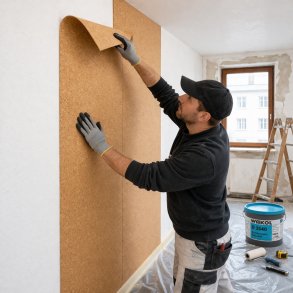
D3540-2,5
In stock
£ 104.54
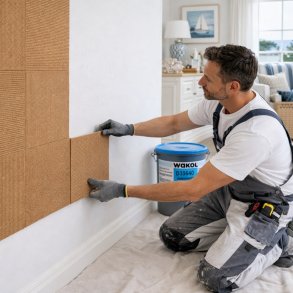
D3540-5,0
- secure payment!
- cheap shipping!
- express delivery!
In stock
£ 136.38
041004005
- secure payment!
- cheap shipping!
- express delivery!
In stock
£ 104.55

3083
- secure payment!
- cheap shipping!
- express delivery!
In stock
£ 69.13

ZPM
Delivery time: 1 week
£ 97.33
ZPD
Delivery time: 1 week
£ 112.63
Customers who bought this product also bought
D3540-2,5
In stock
£ 104.54

KE-50WL1
- secure payment!
- cheap shipping!
- express delivery!
In stock
£ 128.39

KE-40CL1
- secure payment!
- cheap shipping!
- express delivery!
Not in stock
£ 128.39

KE-50GM1
- secure payment!
- cheap shipping!
- express delivery!
In stock
£ 128.39
 Secure payments
 always free shipping
 Highest quality
 Satisfaction Guarantee