


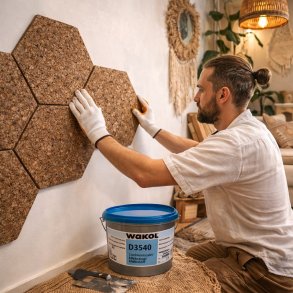
Cork contact adhesive Wakol D 3540 0,8kg
WakolD3540-0,8
- secure payment!
- cheap shipping!
- express delivery!
- cheap shipping!
- express delivery!
In stock
£ 78.33
Most facades look much the same. Render, smooth panels and… more render. But you don't want your home to look like everyone else's. At the same time, looks aren't everything. You also want to be sure you're choosing a material that will stand the test of time, rather than just look good. And that's where the BarCode Expanded Cork Facade Panels bring the two together. After all, why should you have to choose between looks and practicality?
Unique Design

Natural Insulation

100% Cork

For All Seasons

Built to Last

For Facades and Interiors
It's for you if:
The name is no coincidence – the pattern literally resembles a barcode. It's made up of stripes that give the surface its distinctive texture.
This isn't an ordinary flat facade that looks the same all day. The stripes cast shadows that shift as the angle of the light changes. This gives the facade an interesting, three-dimensional appearance.
Beyond its appearance, expanded cork has plenty of practical benefits.
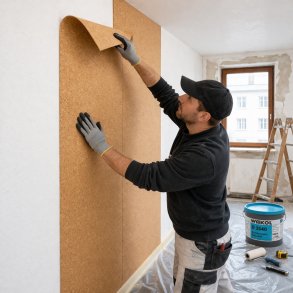
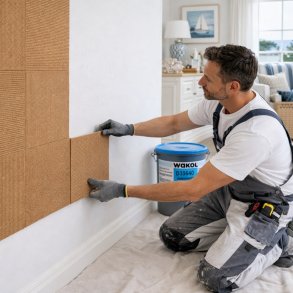
The panels are fixed with adhesive onto a properly prepared surface. The choice of adhesive depends on where you're installing them:
In both cases, the surface needs to be properly prepared (clean, dry, even and stable). If you're still unsure which adhesive to choose, get in touch – we'll help you find the right solution.
You can arrange them in two ways. It all depends on the look you want to achieve:
Which layout is better? There's no single right answer. Both show off the texture of the cork, so the choice mainly comes down to the style of your building and your personal taste.
It's best to use a precision wood saw, a saw blade or another tool with a toothed blade.
The whole process is a bit like making popcorn. Just as popcorn kernels expand when heated, cork granules behave in much the same way. They're heated with steam, causing them to expand, darken and bond together into larger blocks.
Interestingly, no artificial adhesives or additives are needed. The heat releases natural substances within the cork that bind the granules together.
The panels have a density of approximately 140 kg/m³ (±10 kg/m³).
The panels have a thermal conductivity of λ = 0.043 W/(m·K). Cork helps reduce heat loss in winter and prevents walls from heating up as much in summer.
However, remember that the overall insulating performance also depends on the construction of the entire wall.
Each panel measures 1000 × 500 mm, covering 0.5 m² of surface area. For example, you'll need 6 panels to cover 3 m². However, it's worth allowing a little extra for cutting when planning your purchase, especially if your facade has lots of corners, windows or other features you'll need to work around.
The panels are 50 mm thick.
The panels have a Euroclass E reaction to fire rating. Expanded cork is not a non-combustible material, but what matters is how it behaves when exposed to fire. Rather than melting, its surface gradually chars, forming a layer that reduces heat transfer and can slow down further combustion. This is an important difference compared with materials that melt and drip when exposed to high temperatures.
The joints between panels may be slightly visible. This is a natural characteristic of this material. Cork is a material that responds to changes in temperature and humidity, so it's not always possible to achieve a perfectly uniform surface. However, this doesn't mean there will necessarily be large gaps between the panels. Allowing the cork to acclimatise properly before installation and carefully positioning the panels can help reduce this risk.
Yes, this is an important step. Before installation, leave the panels in the room for at least 72 hours to allow the cork to adjust to the temperature and humidity.
If you install the panels straight after delivery, you increase the risk of i.e. gaps forming between them. Allowing three days for acclimatisation helps reduce this risk and achieve more even joints.
Wood, stone, or something that just imitates the real thing? There's a huge range of facade materials to choose from, but finding something genuinely natural isn't always easy. If artificial imitations aren't for you, BarCode Expanded Cork Facade Panels is worth a closer look.

The facade is a big part of your home. You see it from the street, from the garden and every time you come home. So it's hard to think of it as just a protective layer. And not everyone wants their home to look exactly like every other house in the neighbourhood.
BarCode is for anyone looking for something different from ordinary render or smooth panels. The natural texture of cork gives the facade character, while also working really well with modern architecture.
In winter, it helps keep the warmth inside your home, while in summer, it reduces heat build-up in the walls. If you live near a busy road, its sound-insulating properties are another advantage.
A facade also needs to cope with all kinds of weather. Freezing temperatures one day, scorching heat the next, and temperatures changing throughout the day. Expanded cork handles these changes well. It's dimensionally stable, lightweight and vapour-permeable. So it's not just a decorative feature, but a practical choice for your home.
Many facade materials try to imitate nature. They mimic wood, stone or other natural surfaces. But cork doesn't pretend to be anything else. It has its own texture, colour and story. In Portugal, harvesting cork is a tradition passed down through generations. The bark is carefully removed from cork oak trees by hand, without cutting the trees down.
Over time, the bark grows back and can be harvested again. It's a job that takes experience, patience and respect for nature. And that's what makes it so fascinating – a material made from tree bark can be used to clad an entire building.
| Model | BarCode |
| Format | Board |
| Colour | Dark brown |
| Length | 1000 mm |
| Width | 500 mm |
| Thickness | 50 mm |
| Material | Expanded cork |
| Installation | Glue |
| Possibility of return | no return possible (custom made product) |
| Title | Type | Size | Download |
|---|---|---|---|
| Decorative-expanded-3D-facade-wall-natural-cork-insulation-panels-6.pdf | 4.69MB | Download |
D3540-0,8
In stock
£ 78.33
D3540-2,5
In stock
£ 104.54
D3540-5,0
- secure payment!
- cheap shipping!
- express delivery!
In stock
£ 136.38
041004005
- secure payment!
- cheap shipping!
- express delivery!
In stock
£ 104.55
3083
- secure payment!
- cheap shipping!
- express delivery!
In stock
£ 69.13

ZPM
Delivery time: 1 week
£ 97.33
ZPD
Delivery time: 1 week
£ 112.63
Customers who bought this product also bought

KE-40CM1
- secure payment!
- cheap shipping!
- express delivery!
In stock
£ 115.97
3083
- secure payment!
- cheap shipping!
- express delivery!
In stock
£ 69.13
KE-50
In stock
£ 97.06

KEL-60
In stock
£ 109.09
 Secure payments
 always free shipping
 Highest quality
 Satisfaction Guarantee