


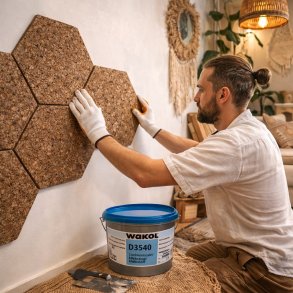
Cork contact adhesive Wakol D 3540 0,8kg
WakolD3540-0,8
- secure payment!
- cheap shipping!
- express delivery!
- cheap shipping!
- express delivery!
In stock
£ 74.72
Polystyrene is something almost everyone is familiar with – mainly because its low price has made it a common choice for insulation. When keeping costs to an absolute minimum is the priority, it can serve its purpose. But what if price isn’t the only thing you care about? Then we recommend Expanded Cork Insulation – an entirely natural material which provides quality insulation. Wondering whether expanded cork is the right choice for your property? Read on – you’ll find all the key information below.

100% Natural Insulation

Year-Round Home Comfort

Reduced Energy Bills

Free From Chemicals

More Warmth, Less Noise

Long-Lasting Performance
Expanded cork is a fully natural insulation material supplied in the form of boards. Its production process is often compared to making popcorn. Cork granules are exposed to very high temperatures (above 350°C), causing them to expand and increase in volume – much like popcorn popping. This creates the distinctive structure of expanded cork, made up of millions of tiny cells filled with air. These microscopic air pockets are what give the material its excellent insulating properties. In practice, it works much like a natural thermos – helping to slow heat transfer while also reducing sound.
As the cork is heated, suberin – a natural resin found in the material – is released. It works as a natural binding agent, joining the granules together into a solid block. This means no synthetic glues or chemical additives are required during production. The granules bond naturally, allowing the finished material to remain 100% natural.
The finished product is a lightweight but solid cork insulation board with low thermal conductivity (λ approx. 0.036–0.040 W/mK). Expanded cork also helps absorb sound waves and can reduce noise by several dozen decibels, depending on the construction system used in a particular project.
Expanded cork is designed to address specific everyday problems, such as walls that feel cold, rooms that become excessively hot in summer, or unwanted echo and noise.
It is especially useful when:
On the other hand, expanded cork may not be the right option if:
Not sure if expanded cork is suitable for what you have in mind? Get in touch with us. Tell us about the wall, room or issue you want to deal with, and we’ll help you choose exactly what you need.
Many cork products you may already know – such as laminate underlays, cork boards and wall coverings – are produced from agglomerated cork. This consists of cork granules joined together using a binder or adhesive and is what we refer to as “regular” cork. It is generally lighter in colour, has a smoother finish and is well suited to wall and floor applications, but it is not primarily intended for more demanding insulation work.
Expanded cork, by comparison, has a dark, nearly black appearance, a more porous texture and stronger insulating properties than standard cork. It is mainly chosen for applications where a higher level of insulation is needed.
If your priority is a decorative surface or a thin cork layer, classic agglomerated cork is the better option. If you want effective thermal and acoustic insulation while keeping the material 100% natural, expanded cork is the solution we recommend.
Very durable. Expanded cork is a stable material designed to perform over the long term. Its structure naturally contains suberin, which helps protect it against moisture penetration and microorganisms. Thanks to this, cork shows resistance to moisture, mould, insects and rodents. When installed as part of a correctly designed building system, it does not serve as a food source for them.
Expanded cork boards also retain their dimensional stability over an exceptionally broad temperature range – from approximately –180°C to +120°C. The material meets EN 13170 and EN 13172 requirements and has a French A+ emissions classification, indicating very low levels of volatile substance emissions inside buildings.
Polystyrene costs less, which is its main advantage over cork. It is one of the most commonly used insulation materials, but when it comes to acoustics, its effect is very limited – in practical terms, almost unnoticeable.
Expanded cork comes at a higher price, but it provides more than thermal insulation alone. As a natural material, it helps reduce heat loss while also making a noticeable difference to room acoustics. Unlike polystyrene, it is made entirely from a natural raw material.
Here is how the two materials compare:
Yes. Before installation, keep the cork in the room where it will be fitted for approximately 72 hours. This gives the material time to adapt to the local temperature and humidity. Because cork is a natural material, installing it immediately after delivery may result in slight dimensional changes later on, such as shrinking or expanding. Acclimatisation helps minimise this risk.
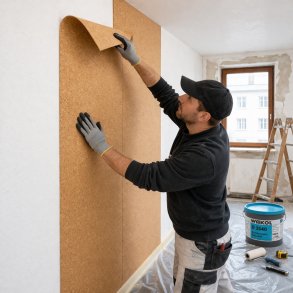
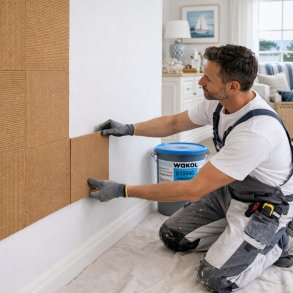
For installation, we recommend using Wakol D-3540 contact adhesive for cork. It is the product we use ourselves for cork installations, and it has proven to be very reliable.
You should allow for approximately 100 g of adhesive per board. In practice, this means:
The adhesive creates a long-lasting bond as long as the wall is dry, clean and even.
Standard expanded cork boards are primarily designed for indoor use. If you plan to install cork on an external façade, Facade Expanded Cork will be a more suitable choice.
Yes. Expanded cork is light, simple to cut and can be used successfully in terrariums intended to recreate a natural-looking habitat. If, however, you need cork products made specifically with terrariums in mind, have a look at our dedicated range of branches, tubes and other decorative elements made from natural cork. They are particularly well suited to this purpose because they can provide natural hiding spots as well as surfaces for climbing.
Yes. The best results are usually achieved with dedicated cork paints.
Bear in mind, however, that expanded cork has a naturally porous and uneven surface. Because of this, creating a perfectly smooth and completely uniform layer of paint can be more challenging.
Do the walls in your home always seem cold to the touch? Is the heating running, but the rooms still don’t feel properly warm? Over time, this can mean higher energy bills without giving you the level of comfort you expect. This is one of the reasons why more homeowners are turning to expanded cork as a way to deal with these issues.

Its thermal insulation performance helps cork keep indoor temperatures comfortable and more consistent throughout the year. During winter, it helps retain warmth inside the building, while in summer it slows down the rate at which rooms heat up. This can reduce the amount of energy required for both heating and air conditioning, helping you stay comfortable whatever the weather is like outside.
Expanded cork boards can preserve their insulating properties for decades, in many cases for around 50 years. That means one properly installed insulation layer can continue working for a very long time, without the need for frequent replacement or ongoing repairs.
Expanded cork belongs to a small group of insulation materials that are entirely natural. It is produced from cork granules alone, without synthetic adhesives or artificial resins. It does not release harmful substances or create dust, making it a particularly good option for homes where maintaining a healthy indoor environment is a priority, including households with children or allergy sufferers.
That is worth considering because we spend so much of our lives indoors. When choosing building materials, it makes sense to think not only about how they look or perform, but also about what goes into them. Plastic is already present in so many parts of everyday life, so reducing the amount of synthetic material used inside the home can be a real advantage.
Cork is a genuinely environmentally responsible material. Plenty of products are marketed as “eco-friendly” today, sometimes without much substance behind the claim, but cork has a strong environmental case. It comes from the bark of the cork oak, which can be harvested without felling the tree. What’s more, while the bark grows back, the tree absorbs increased amounts of carbon dioxide, helping cork production maintain a very low carbon footprint.
By comparison, insulation materials such as polystyrene and mineral wool are considerably less favourable from an environmental perspective. Their manufacture depends on energy-intensive industrial processes that place a greater burden on the environment. Cork, on the other hand, is renewable, natural and ecological by its very nature – not simply because of a marketing label.
| Format | Board |
| Colour | Dark brown |
| Length | 1000 mm |
| Width | 500 mm |
| Thickness | 30 mm |
| Material | Expanded cork |
| Installation | Glue |
D3540-0,8
In stock
£ 74.72
D3540-2,5
In stock
£ 99.72
D3540-5,0
- secure payment!
- cheap shipping!
- express delivery!
In stock
£ 130.09
041004005
- secure payment!
- cheap shipping!
- express delivery!
In stock
£ 99.72
3083
- secure payment!
- cheap shipping!
- express delivery!
In stock
£ 65.94

ZPM
Delivery time: 1 week
£ 92.84
ZPD
Delivery time: 1 week
£ 107.43
Customers who bought this product also bought
PK5K100
- secure payment!
- cheap shipping!
- express delivery!
In stock
£ 55.57
RK1050SM
- secure payment!
- cheap shipping!
- express delivery!
In stock
£ 124.16
TKS10-30
In stock
£ 72.93
PGK-6MM(1)
- secure payment!
- cheap shipping!
- express delivery!
In stock
£ 134.53
 Secure payments
 always free shipping
 Highest quality
 Satisfaction Guarantee